%201.svg)


.png)


Goodcall is an entry-level AI receptionist for solopreneurs and micro-businesses. It answers calls, captures leads, and handles basic FAQs at a flat monthly price with unlimited minutes.
But as businesses grow, the limitations surface quickly. Each pricing tier caps the number of unique callers who can reach you per month: 100 on Starter, 250 on Growth, 500 on Scale. Go past the cap, and you're paying $0.50 per additional caller. Seasonal spikes in HVAC, roofing, or dental can blow through those limits in a week. Integrations run only through Zapier, which adds latency and requires another subscription. Language support stops at roughly 7 languages. And the voice quality, while functional, still sounds noticeably robotic compared to newer platforms.
If any of that sounds familiar, this list covers 9 alternatives worth evaluating.
Why teams look beyond Goodcall
If you’re evaluating Goodcall, there are reasons to evaluate the alternatives as well, because here’s where Goodcall starts limiting your business.
Unique caller caps limit growth
Goodcall charges by unique callers per month rather than minutes. That sounds good until a busy season hits. An HVAC company running a summer campaign might get 300 different callers in a week. On the Starter plan (100-caller cap), that's $100+ in overages on top of the $79 base. The pricing model punishes growth instead of rewarding it.
Integrations are shallow
Goodcall connects to CRMs and calendars through Zapier, not native integrations. That adds latency, requires another subscription, and limits the real-time data that flows between systems. If you need the AI to pull up a caller's account history mid-call or log a structured outcome to your CRM, Zapier won't cut it.
Based on our competitor analysis, Goodcall's post-call visibility is limited to transcripts (recordings require consent) and no actionable summaries. Compare that to platforms like SquawkVoice, which provide recordings, transcripts, summaries, and structured actions after every call.
Limited language support
At roughly 7 languages, Goodcall falls short for businesses serving multilingual communities. Platforms like SquawkVoice (30+) or Vapi (100+) handle this natively without add-ons.
Voice quality feels dated
Multiple reviewers note Goodcall's voice carries a robotic quality compared to newer GPT-4o-powered platforms. For businesses where the caller experience directly impacts revenue (dental offices, med spas, real estate), that gap matters.
The UX isn't winning anyone over
Our hands-on comparison rated Goodcall's overall UX as "not very appealing and intuitive" compared to SquawkVoice's simpler interface. The dashboard design, while functional, doesn't match the clean, grouped menu structure offered by newer platforms.
Head-to-head: how Goodcall compares on key capabilities
We evaluated Goodcall against SquawkVoice across the core capabilities that matter for inbound call handling. Here's how they stack up:
Source: SquawkVoice internal competitor analysis (2025)
9 best Goodcall alternatives (compared)
1. SquawkVoice: Best overall alternative
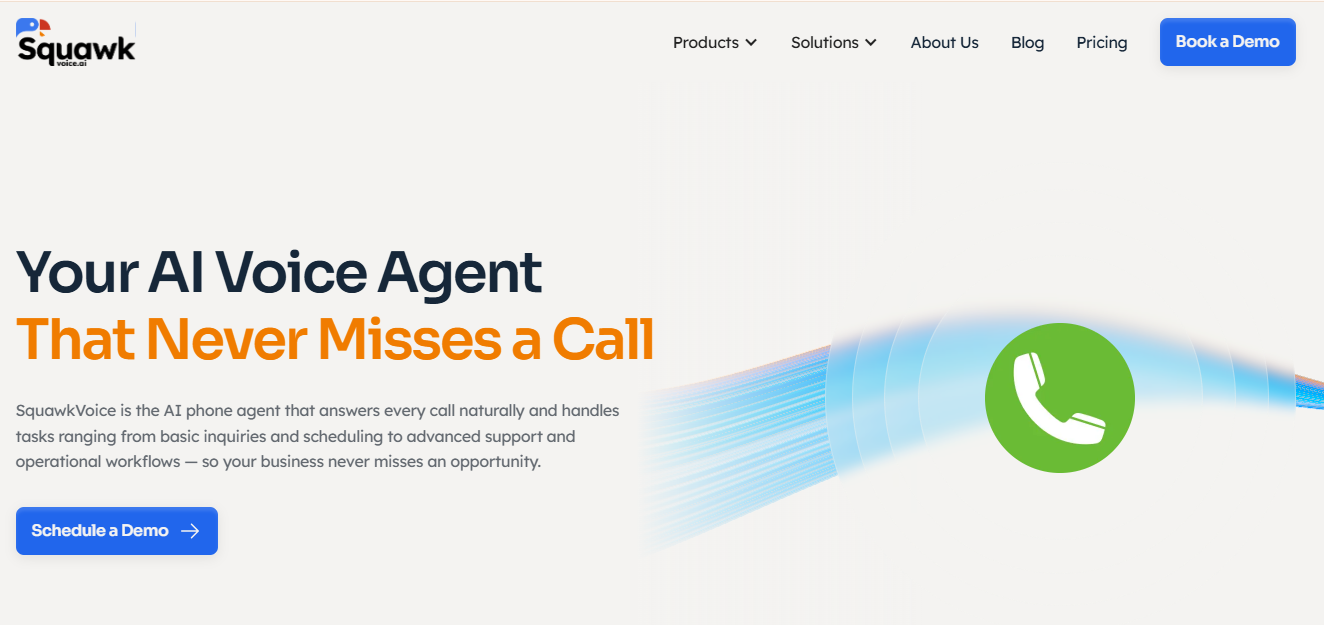
SquawkVoice answers every inbound call 24/7 with natural-sounding AI, qualifies leads, books appointments, and escalates complex issues to humans with full context. No caller caps, no per-unique-customer charges.
Key strengths: Mobile app for on-the-go management, 40+ languages, native CRM and calendar integrations (including Freshworks), call recordings with transcripts and structured summaries, and a real-time analytics dashboard. The platform offers 20+ voice options with accent customization, stability tuning, and personality controls, which is significantly more voice configuration than Goodcall provides.
Pricing: $0.20/min usage-based. 50 free calls on trial. No platform fees or caller caps.
Limitations: Newer platform (founded in 2024), the integration ecosystem is still expanding. Inbound-focused, not built for outbound campaigns.
Best for: Dental offices, HVAC companies, med spas, healthcare clinics, electricians, roofers, and growing SMBs that can't afford to miss calls or cap their growth. Also well suited for multi-location service businesses and mid-market teams that need backend CRM integrations, structured post-call analytics, and more complex workflow management. The WebApp handles that layer of complexity out of the box.
2. Synthflow: Best for agencies and outbound campaigns
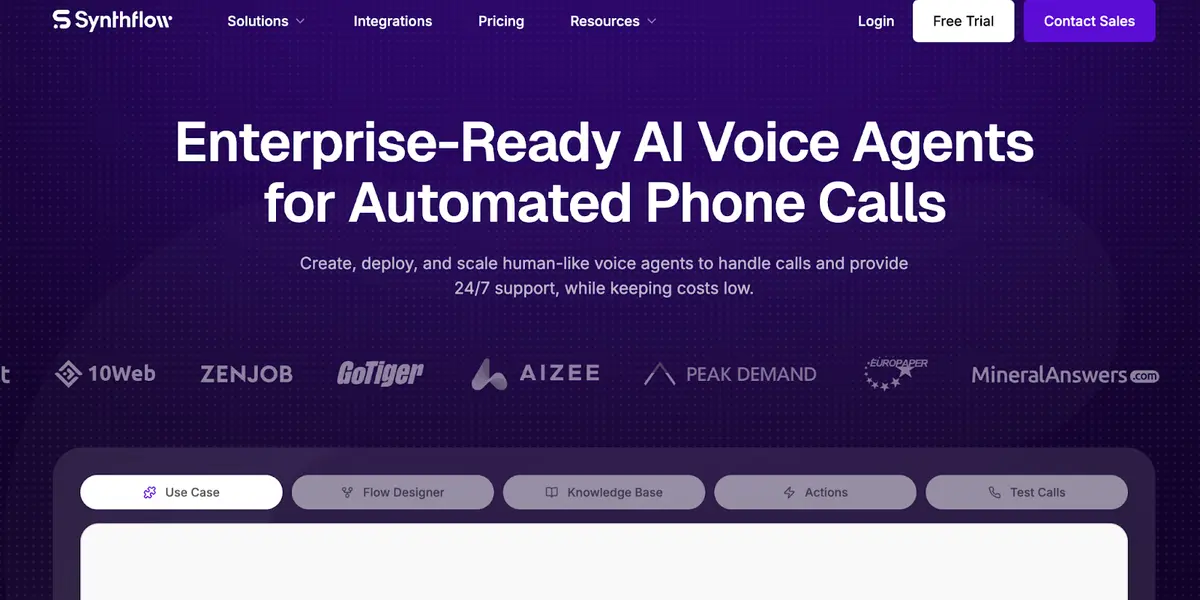
Synthflow is a no-code voice AI builder with a drag-and-drop flow designer. Where Goodcall focuses on simple inbound answering, Synthflow handles complex outbound campaigns, white-labeling, and custom agent design.
Key strengths: Unlimited agents, 200+ integrations, 20+ languages, white-label and sub-account system, outbound campaign tools with lead list uploads.
That said, our evaluation found that Synthflow's menu options are complicated and that the setup requires technical expertise. Post-call visibility is weaker too: recordings and transcripts are available, but actionable summaries are missing unless you customize them. The agent list view is also clunky. There's no icon view to see what each agent does at a glance. You have to click into each one individually.
Pricing: Pay-as-you-go from ~$0.11–$0.16/min (component-based: voice engine, LLM, and telephony billed separately). Enterprise from ~$0.08/min.
Limitations: Pricing gets complicated: voice, LLM, and telephony are billed separately. Customer support is slow across G2 and Trustpilot (138 mentions of pricing at scale being expensive). Calendar integrations are not straightforward.
Best for: Agencies reselling voice AI, sales teams running outbound campaigns, mid-market businesses with 200+ calls/month.
3. ServiceAgent.ai: Best for home services
ServiceAgent.ai trains its AI specifically for home service industries: HVAC, plumbing, electrical, and roofing. The agent handles intake, qualifies leads (including verifying homeownership), and books appointments directly on your team's calendar.
Key strengths: Industry-specific AI training, CRM integration, payment processing, and dispatch integration.
Pricing: Contact for pricing. Positioned for businesses doing $1M+ revenue.
Limitations: Not for solopreneurs or micro-businesses. Focused on the home services vertical only.
Best for: Growing home service businesses that need an AI trained on their specific workflows, not just a generic call answerer.
4. Retell AI: Best for developers
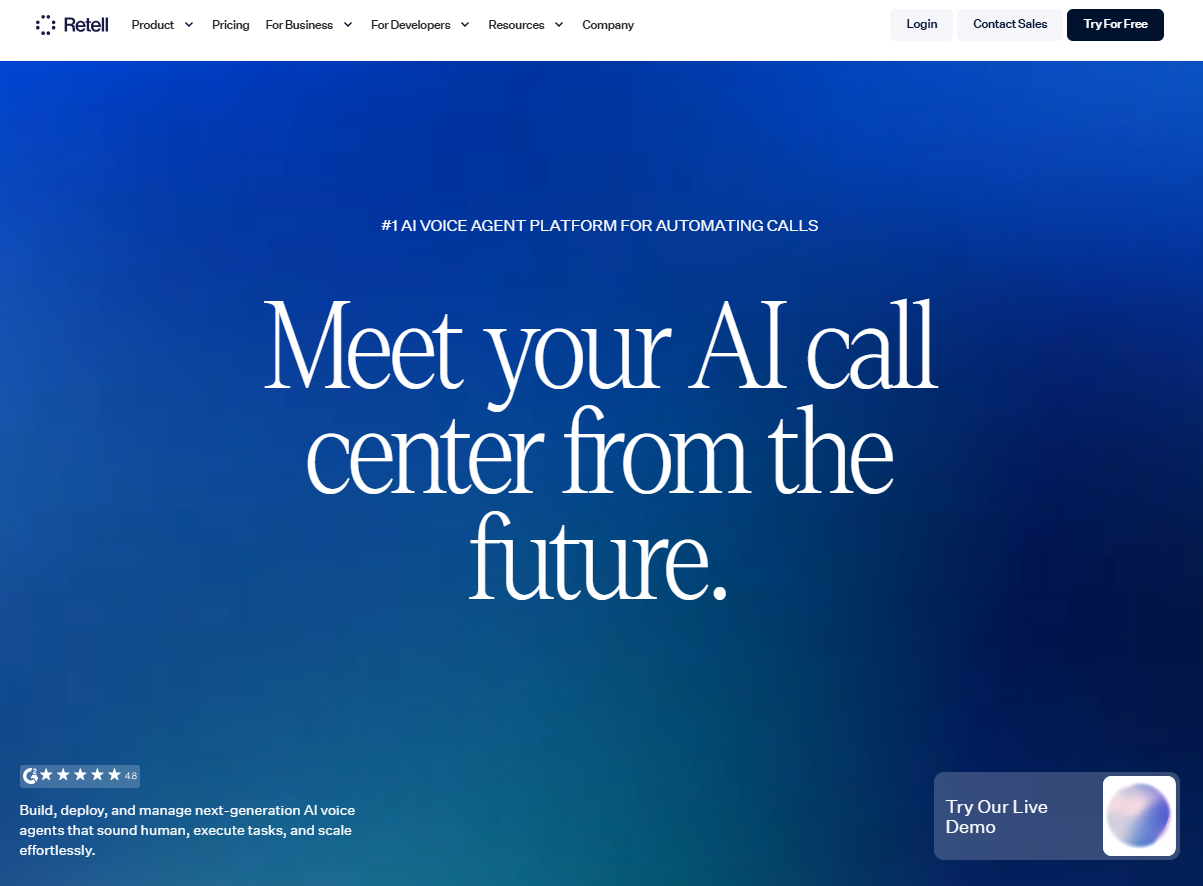
Retell AI is a developer-first voice API. You bring your own LLM, choose your voice engine, and connect telephony. Maximum control, minimum hand-holding.
Key strengths: Sub-second latency, pay-as-you-go pricing starting at $0.07/min, SOC 2 and HIPAA compliance, visual builder plus full API.
Pricing: $0.07–$0.08/min voice engine + LLM + telephony. Real-world all-in: $0.13–$0.31/min depending on configuration.
Limitations: Requires engineering resources. Not plug-and-play. Cost forecasting is complex with stacked billing across multiple vendors.
Best for: Engineering teams building custom voice products or large call centers with developer resources.
5. Smith.ai: Best hybrid (AI + human backup)
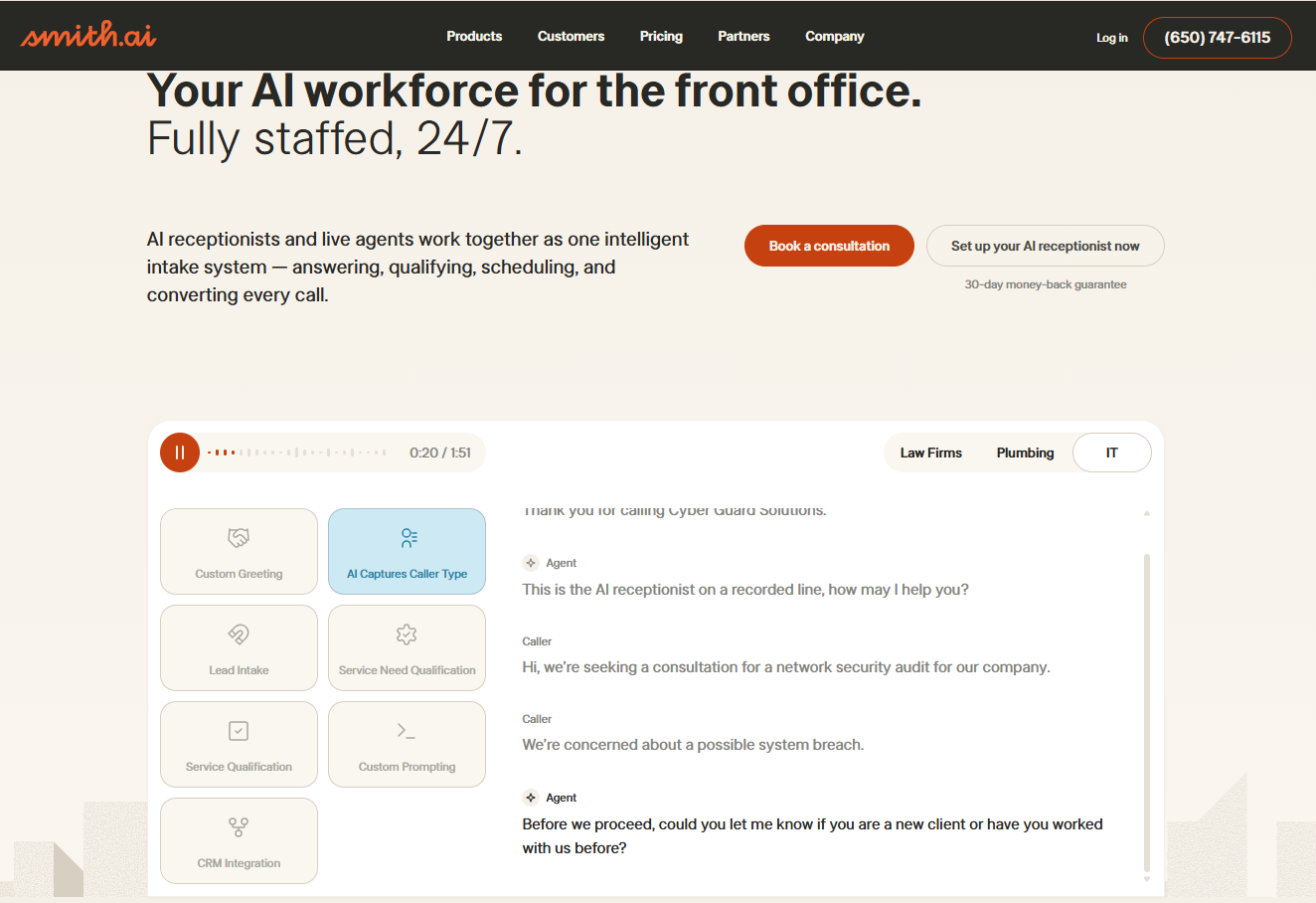
Smith.ai combines AI with real human receptionists. The AI handles routine calls; complex or sensitive calls route to a live person. If you want a safety net for high-value callers, this is the only option on the list that offers it.
Key strengths: AI + human backup, appointment booking, lead intake, bilingual (English/Spanish), CRM integrations.
Pricing: AI Receptionist plans from $95/month for 30 calls ($2.40/call overage). Human-backed plans from $292.50/month for 30 calls ($9.75/call overage).
Limitations: Expensive at scale. Per-call pricing adds up fast for high-volume businesses.
Best for: Law firms, financial advisors, and businesses where a bad AI interaction with a high-value prospect is too risky.
6. Bland AI: Best for enterprise-scale outbound
Bland AI is built for teams running thousands of calls daily. Self-hosted infrastructure with custom voice models gives enterprises full control.
Our evaluation found Bland's setup requires solid technical expertise. Call actions are distributed between the dashboard and APIs, so configuring them isn't as centralized as SquawkVoice's single-location approach. Post-call visibility includes recordings, transcripts, and summaries, but lacks structured actions.
Key strengths: Up to 1M concurrent calls, voice cloning, conversational pathways, multi-region deployment, HIPAA compliant.
Pricing: $0.09/min for connected calls on the base (Start) plan. Optional tiered subscriptions: Build plan at $299/month and Scale at $499/month unlock lower per-minute rates and higher concurrency. Enterprise plans are custom.
Limitations: Developer-first: requires API experience, not for small businesses. The tiered plan structure introduced in late 2025 adds a subscription fee on top of per-minute billing. Overall, the UX needs some technical expertise to navigate.
Best for: Large enterprises running high-volume outbound campaigns with in-house engineering.
7. Dialzara: Best budget alternative

Dialzara is a lightweight AI answering service that gets you live in under 15 minutes. You answer a few questions, pick a voice, and calls start routing. No engineering required.
Key strengths: Fast setup (under 15 minutes), natural-sounding voices, workflows and integrations included on higher plans, white-label available, multilingual support (English, Spanish, French, German, and more).
Pricing: Starter from $29/month (60 minutes included). Mid-tier plans around $69–$97/month with more minutes and advanced features. Overage at $0.48/min across all plans. No setup fees, no long-term contracts.
Limitations: Less customizable than platforms like Synthflow or Retell. Feature depth is thinner for complex use cases. Overage rate ($0.48/min) is high if call volume spikes beyond your plan.
Best for: Budget-conscious small businesses that want a step up from Goodcall without a steep learning curve.
8. PolyAI: Best for large enterprise contact centers
PolyAI builds voice assistants for the largest companies. This isn't self-serve: they build the agent, train it on your industry, and manage performance with a 99.9% uptime SLA.
Key strengths: Pre-trained industry assistants, handles accents and noisy lines, deep multilingual support, fully managed service.
Pricing: Annual contracts from ~$150K. Custom based on volume.
Limitations: Enterprise budget required. No self-serve option.
Best for: Large enterprises with strict compliance needs and high-volume contact center operations.
9. Vapi: Best for developer flexibility
Vapi is a middleware platform where you plug in your own speech-to-text, LLM, and text-to-speech providers. Full BYO stack, maximum flexibility.
Our hands-on evaluation found that Vapi's call actions require extensive coding, and the knowledge base setup is buried in the menu under "More > Files." It supports PDFs and docs natively, but anything deeper requires API keys. Setup effort is steep for non-developers.
Key strengths: 100+ languages, $0.05/min platform fee, automated testing tools, A/B testing for prompts and voices.
Pricing: $0.05/min platform fee + provider costs (LLM, STT, TTS, telephony billed separately). Real-world all-in: $0.23–$0.33/min.
Limitations: Steep learning curve. Managing multiple vendor relationships and billing cycles. Phone numbers limited to US/CA by default.
Best for: Technical teams that want complete control over every layer of the voice stack.
Quick comparison table
Snapshot comparison: setup, visibility, and analytics
Beyond pricing and feature lists, the day-to-day experience matters. Here's how the major platforms compare on usability, post-call visibility, and analytics based on our hands-on evaluation:
Source: SquawkVoice competitor analysis across all platforms (2025)
The best Goodcall alternative for most businesses
For businesses that have outgrown Goodcall's caller caps and need something more capable without a steep learning curve, SquawkVoice is the most practical upgrade.
The mobile app lets SMB owners set up and manage their AI receptionist from their phone, closer to Goodcall's simplicity than enterprise platforms like Synthflow or Retell. For mid-market teams with more complex needs, the WebApp handles backend integrations, CRM lookups, and structured analytics without requiring developer involvement. Unlike Goodcall, there are no unique caller limits. You pay $0.20/min for every call, and that rate stays flat regardless of how many different people call you.
Multilingual support covers 40+ languages, which matters for dental practices, med spas, and service businesses in diverse communities. Call recordings, transcripts, structured summaries, and analytics come standard, not gated behind higher plans. And for businesses already on Freshworks, SquawkVoice integrates natively without Zapier as a middleman.
Who should choose SquawkVoice: Dental offices, healthcare clinics, med spas, HVAC contractors, electricians, roofers, and growing SMBs that need reliable call answering without growth penalties. For mid-market businesses running multiple locations or managing CRM-integrated call workflows, SquawkVoice's WebApp handles that additional complexity out of the box.
Understand why SquawkVoice is not just Good, but better than Goodcall
Request a Demo →
Making the right choice for your business
Goodcall still works for solopreneurs handling under 100 unique callers a month who need basic call answering at a predictable price. If that describes your business today, there's no urgency to switch.
But if you're hitting caller caps, frustrated by Zapier-only integrations, or losing callers who notice the robotic voice quality, the alternatives here cover every use case. SquawkVoice is the best all-around upgrade for SMBs and mid-market teams. Synthflow fits agencies and outbound teams. Retell AI and Vapi serve developer teams. And PolyAI handles enterprise scale.
Frequently asked questions
What is the best alternative to Goodcall?
For most businesses, SquawkVoice is the best overall alternative: 24/7 AI answering, no caller caps, mobile app management, 40+ languages, native integrations, and flat $0.20/min pricing with 50 free trial calls.
Which Goodcall alternative is best for small businesses?
SquawkVoice and Dialzara. SquawkVoice's mobile app gets you live in minutes with no caller limits. Dialzara offers a quick setup starting at $29/month for budget-conscious teams.
Is there a free alternative to Goodcall?
No fully free alternatives exist. Retell AI offers $10 in free credits. SquawkVoice includes 50 free calls on trial. Goodcall itself offers a 14-day free trial.
Why is Goodcall's unique caller pricing a problem?
Because it punishes growth: every new caller beyond your cap costs you money, which means seasonal spikes, marketing campaigns, or simply being busy can trigger overages. Per-minute pricing (like SquawkVoice's $0.20/min) scales more predictably.
Does Goodcall support multilingual calls?
Goodcall supports roughly 7 languages. If you need broader coverage, SquawkVoice offers 40+ languages, and Vapi supports 100+.