%201.svg)


.png)


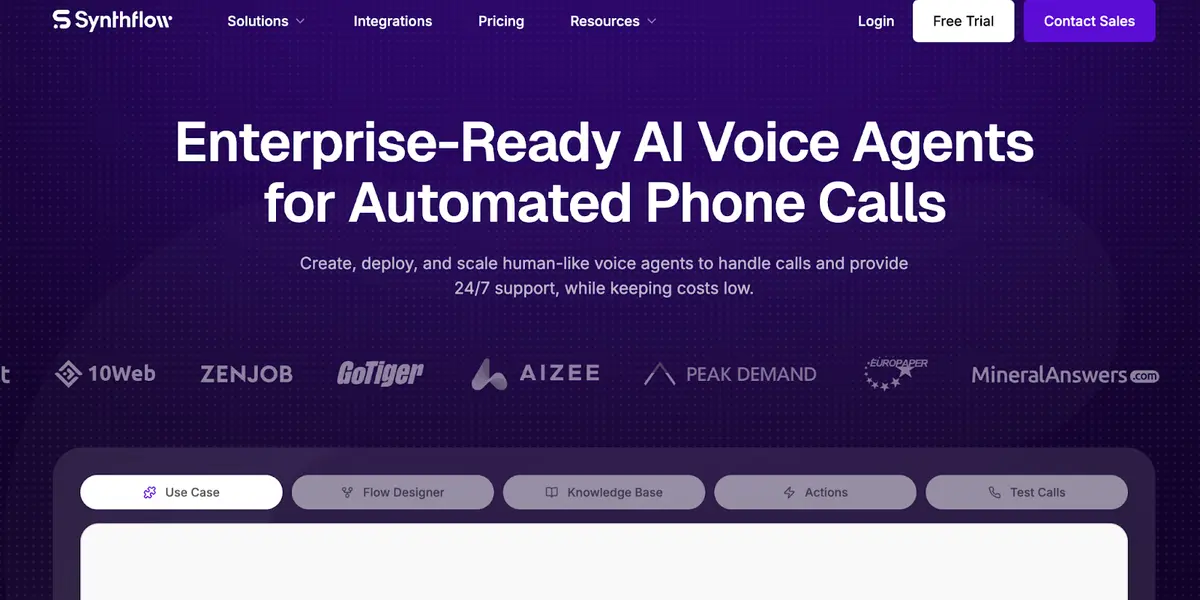
Synthflow made a name for itself as a no-code voice AI platform. And for straightforward use cases, it still works. But as teams scale, the cracks show up fast: per-minute costs that balloon past your budget, latency issues that make agents sound robotic mid-conversation, and support tickets that go unanswered for days.
If you've been running into these problems, or you're doing your homework before committing, this list covers 11 AI voice agent platforms worth evaluating. Every tool here handles real phone automation, not chatbot demos.
Common pain points that make teams look beyond Synthflow
Before jumping into alternatives, it’s worth understanding what drives people away from Synthflow in the first place. User reviews confirmed several of these gaps.
Pricing escalates quickly at scale
Synthflow’s component-based billing means your real cost is the sum of the voice engine ($0.09/min), LLM ($0.02–$0.05/min), and telephony ($0.00–$0.02/min). Most pay-as-you-go setups fall between $0.15 and $0.24 per minute. Add Performance Routing ($0.04/min) and Low Latency Edge ($0.04/min), and a $0.11/min configuration becomes $0.19/min. Multiple G2 reviewers flag pricing as their top concern, with 138 cost-related complaints in user reviews.
Post-call visibility is thin
Synthflow provides recordings and transcripts, but actionable summaries are not available unless you customize them. And analytics tied to outcomes? Also not available out of the box. Synthflow’s post-call visibility is “Partially Yes” compared to SquawkVoice’s full “Yes.”
Even more notable: the Raw Data evaluation found no call recording on the standard plan — only transcripts. If your compliance or QA process requires recordings, that’s a gap you’ll need to work around.
Customer support is slow or unresponsive
Trustpilot reviews (211+ at time of writing) include repeated reports of unanswered emails, unresolved billing disputes, and week-long wait times for support. Private Slack access is limited to the first 30 days of onboarding, after which you’re routed to a ticketing system.
The UX doesn’t scale well
Synthflow’s UX/Dashboard design is “Complicated Menu Options”. The agent list view is a good example: there’s no icon view to see what each agent does at a glance. You have to click into each one individually, which is cumbersome when you’re managing multiple agents.
How Synthflow actually stacks up against SquawkVoice: The evaluation data
SquawkVoice is an AI voice platform built primarily for inbound call handling: answering calls, qualifying leads, booking appointments, and escalating to humans when needed. It comes as a mobile app (for SMBs who want to set up in minutes) and a web app (for mid-market teams who need integrations and custom workflows).
Here's where it stands out from the rest of the field, including Synthflow.
Setup speed: Most platforms in this space, including Synthflow, require meaningful configuration before a single call can be handled well. SquawkVoice ships production-ready agents. The mobile app is live in under 5 minutes.
Post-call data, without the work: Recordings, transcripts, structured summaries, and action logs come included on every plan. No customization needed. Platforms like Synthflow, Bland, and Vapi require you to build this yourself or go without.
Outcome-level analytics: Most voice AI tools give you call volume and transcripts. SquawkVoice tracks outcomes, actions taken, and resolution trends, and gives leaders a granular view of call resolution rather than just agent-level metrics.
Lead tracking: Synthflow doesn't track leads in the platform. SquawkVoice surfaces them in the analytics dashboard.
Mobile management: No other platform on this list has a mobile app for SMB owners. If you run a service business and manage things from your phone, that's a meaningful difference.
Before looking at alternatives, here’s a comprehensive look at how Synthflow performed across 18 capabilities in our comparison:
Source: SquawkVoice competitor analysis, Synthflow evaluation sheet, and Snapshot Comparison (2025)
At a higher level, here’s the five-capability marketing comparison:
Source: SquawkVoice marketing comparison matrix (2025)
Synthflow performs well in core capability (handling calls autonomously) but falls short in readiness, ease of use, visibility, and UX. That’s the pattern of a builder-first platform: you get power and flexibility, but you’re paying for it in setup time and operational overhead.
Want to see SquawkVoice in action before you decide?
Request a Demo→
11 Best Synthflow alternatives (compared)
1. SquawkVoice: Best overall alternative
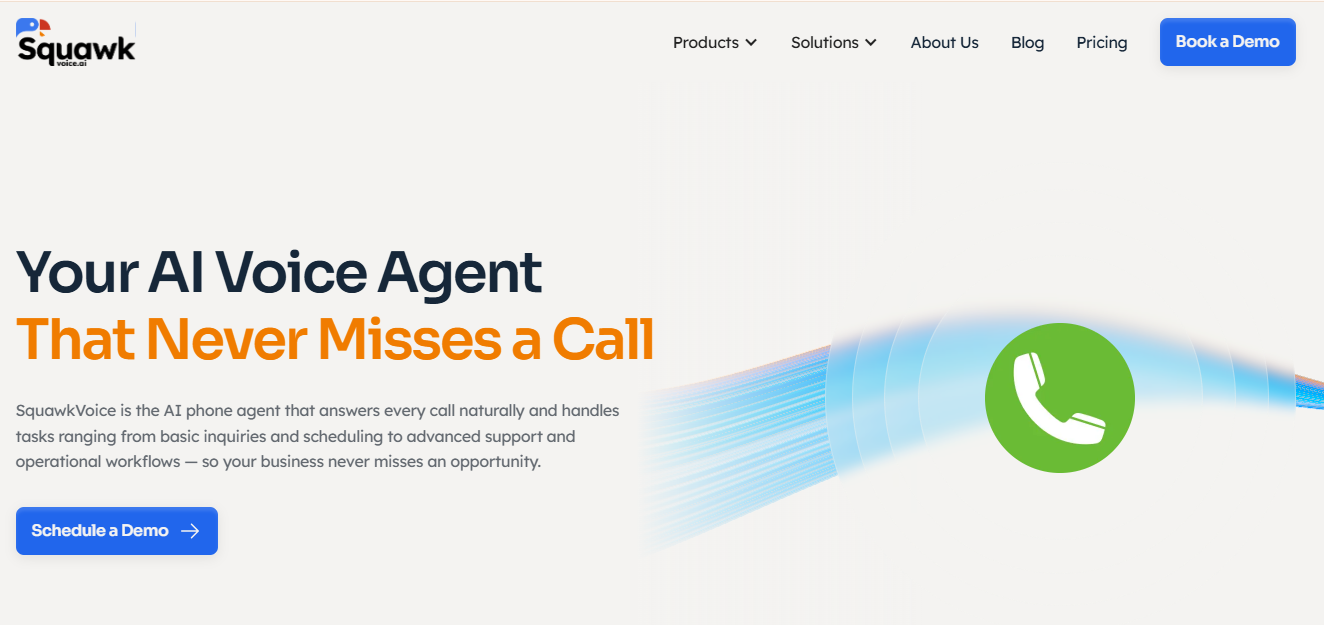
SquawkVoice is an AI voice platform that answers inbound calls, resolves routine requests, and escalates complex issues to live agents with full context. What sets it apart is the combination of a mobile app for on-the-go management and a web app for more complex enterprise workflows — all on a flat, per-minute pricing model.
Key strengths:
- 24/7 AI receptionist that answers instantly.
- The mobile app gets you live in minutes; the web app handles multi-step enterprise workflows.
- Connects to CRMs (including Freshworks), calendars, and backend systems for real-time actions during calls.
- Multilingual voice support across 30+ languages.
- Call recordings, transcripts, summaries, and structured action items after every call. Analytics dashboard tracking call volume, resolution rates, and sentiment.
From our evaluation, SquawkVoice was the only platform rated “Green” across all 18 capabilities tested. The platform offers 20+ voice options with accent customization, stability tuning, and personality controls. The agent icon view gives a one-stop snapshot of all built AI agents — a UX detail that matters when you’re managing multiple agents across locations.
Pricing: $0.20/min usage-based. 50 free calls on trial. No platform fees or caller caps.
Limitations: Newer platform (founded in 2024); the integration ecosystem is still growing. No outbound calling focus — this is built for inbound.
Best for: Dental offices, healthcare clinics, med spas, HVAC contractors, electricians, roofers, and growing SMBs that can’t afford to miss calls.
2. Retell AI: Best for developers and transparent pricing
Retell AI is a developer-first voice API platform. You bring your own LLM, choose your voice engine, and connect your telephony — Retell handles the orchestration.
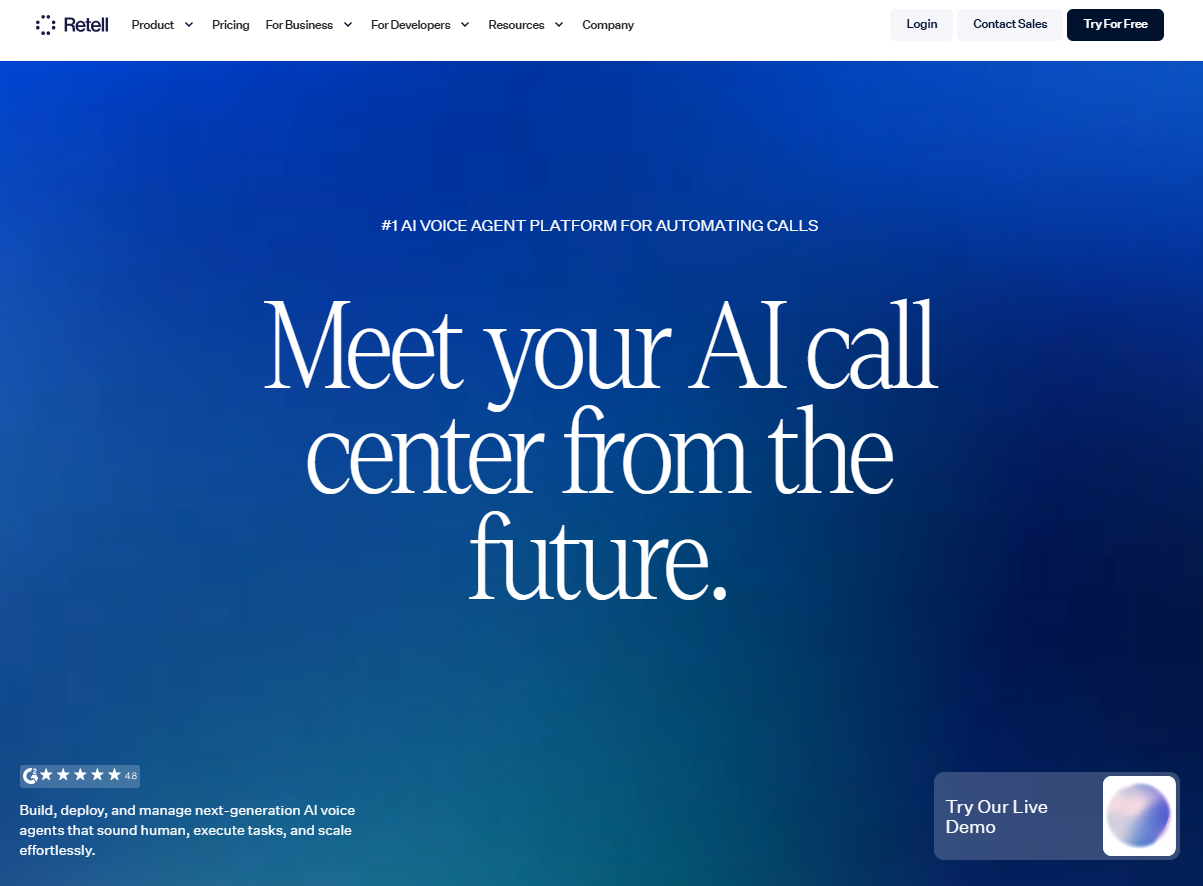
Key strengths: Sub-second latency with streaming call support. Pay-as-you-go pricing starting at $0.07/min (voice engine only). SOC 2 and HIPAA compliant. Supports barge-in (the agent stops talking when the caller interrupts). Visual builder for conversation flows alongside full API access.
Pricing: $0.07–$0.08/min for voice engine, plus LLM costs ($0.003–$0.08/min) and telephony (~$0.015/min). Real-world all-in cost: $0.13–$0.31/min depending on configuration.
Limitations: Not plug-and-play. Requires engineering resources to build, deploy, and maintain. Costs can be hard to forecast when billing components are stacked.
Best for: Engineering teams building custom voice products, software companies adding voice as a feature, and large call centers with developer resources.
3. Bland AI: Best for enterprise-scale outbound
Bland AI is built for teams running thousands of calls a day. Self-hosted infrastructure with custom voice models gives enterprises full control over agent behavior.
Our evaluation found that Bland’s setup requires technical expertise and that its call actions are distributed between the dashboard and APIs. Post-call visibility includes recordings, transcripts, and summaries, but no structured actions. Overall, the UX was rated as “complicated and needs some level of technical expertise.”
Key strengths: Up to 1M concurrent calls, voice cloning, conversational pathways for dialog control, multi-region deployment, HIPAA compliant.
Pricing: $0.09/min for connected calls. Enterprise plans are custom.
Limitations: Developer-first — requires API experience, not for small businesses.
Best for: Large enterprises running high-volume outbound campaigns with in-house engineering teams.
4. Vapi: Best for developer flexibility
Vapi is a middleware platform that sits between your phone system and your AI models. You plug in your own speech-to-text, LLM, and text-to-speech providers, and Vapi orchestrates the call flow.
Our evaluation found that Vapi’s call actions require extensive coding, and the knowledge base setup is buried in the menu under “More > Files.” It supports PDFs and docs natively, but anything deeper requires API keys. Setup was rated “steep for non-devs” due to the complexity of the menu options.
Key strengths: Full BYO stack (choose your own LLM, voice engine, telephony). 100+ languages. Automated testing tools for hallucination detection. A/B testing for prompts and voice selection. $10 in free credits to start.
Pricing: $0.05/min platform fee plus provider costs. Real-world all-in cost: $0.23–$0.33/min.
Limitations: Steep learning curve. Managing multiple vendor relationships and APIs. Phone numbers limited to US/CA by default. Support is community-based (Discord).
Best for: Technical teams that want complete control over every layer of the voice stack.
5. PolyAI: Best for large enterprise contact centers
PolyAI builds voice assistants for the largest companies. This isn’t self-serve — they build the agent, train it on your industry, and manage performance.
Key strengths: Pre-trained industry assistants (banking, insurance, hospitality, healthcare), handles accents and noisy lines, managed service with 99.9% uptime SLA, deep multilingual support.
Pricing: Annual contracts from ~$150K. Custom based on volume.
Limitations: Enterprise budget required. No self-serve. Overkill for SMBs.
Best for: Large enterprises with strict compliance needs and high-volume contact center operations.
6. Lindy: Best for non-technical teams with multi-channel needs

Lindy handles calls alongside email, calendar, and task automation from a single interface. No coding required — you set up agents by chatting with the platform.
Key strengths: Multi-channel (voice, email, chat, calendar), no-code conversational setup, 30+ languages, CRM integrations.
Pricing: Credit-based model. Contact Lindy for specifics.
Limitations: Voice features aren’t as robust as those of dedicated voice platforms. Call stability doesn’t match purpose-built tools.
Best for: Small teams that need voice plus email and calendar automation without developers.
7. Voiceflow: Best for design-first conversation building
Voiceflow is a visual conversation design tool for teams building both voice and chat agents. Popular with product and UX teams who want collaboration features and version control.
Key strengths: Powerful visual conversation designer with branching logic, team collaboration tools, supports both voice and chat, a large community, and a template library.
Pricing: Free plan available. Pro plans from $50/month.
Limitations: More of a design/prototyping tool than a production telephony platform. You’ll need external telephony for live phone calls.
Best for: Product teams designing conversation flows who will deploy through a separate telephony stack.
8. CallBotics: Best for contact center automation from SOPs
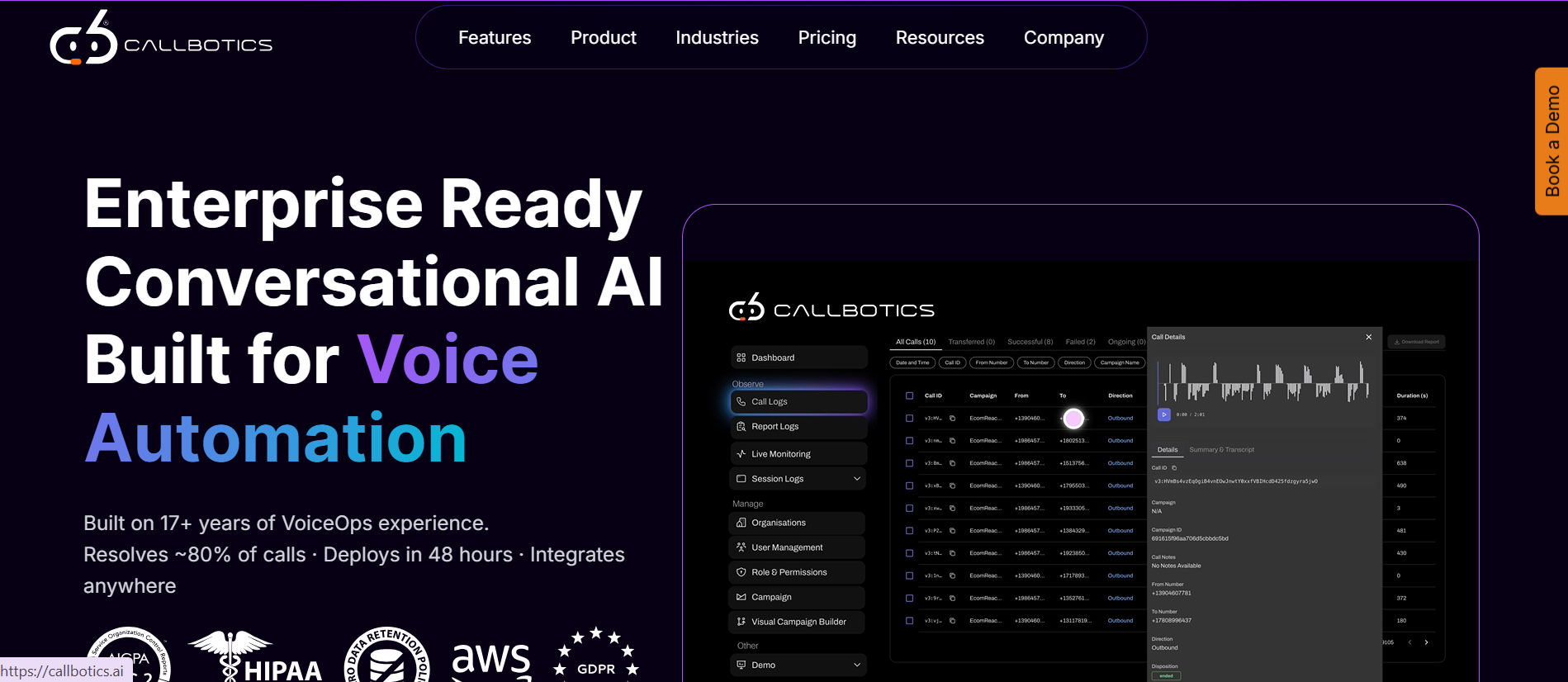
CallBotics takes your existing SOPs, PDFs, and call recordings and turns them into production-ready AI agents. With 17 years of VoiceOps experience, they deploy in approximately 48 hours.
Key strengths: Agents built from your existing documentation, fast go-live, built-in QA, and analytics.
Pricing: Custom pricing based on deployment complexity and call volume.
Limitations: Not self-serve. Best for contact centers with existing documentation, not small businesses.
Best for: Mid-to-large contact centers that want AI agents modeled on their existing processes.
9. CloudTalk: Best for sales and support teams on a budget
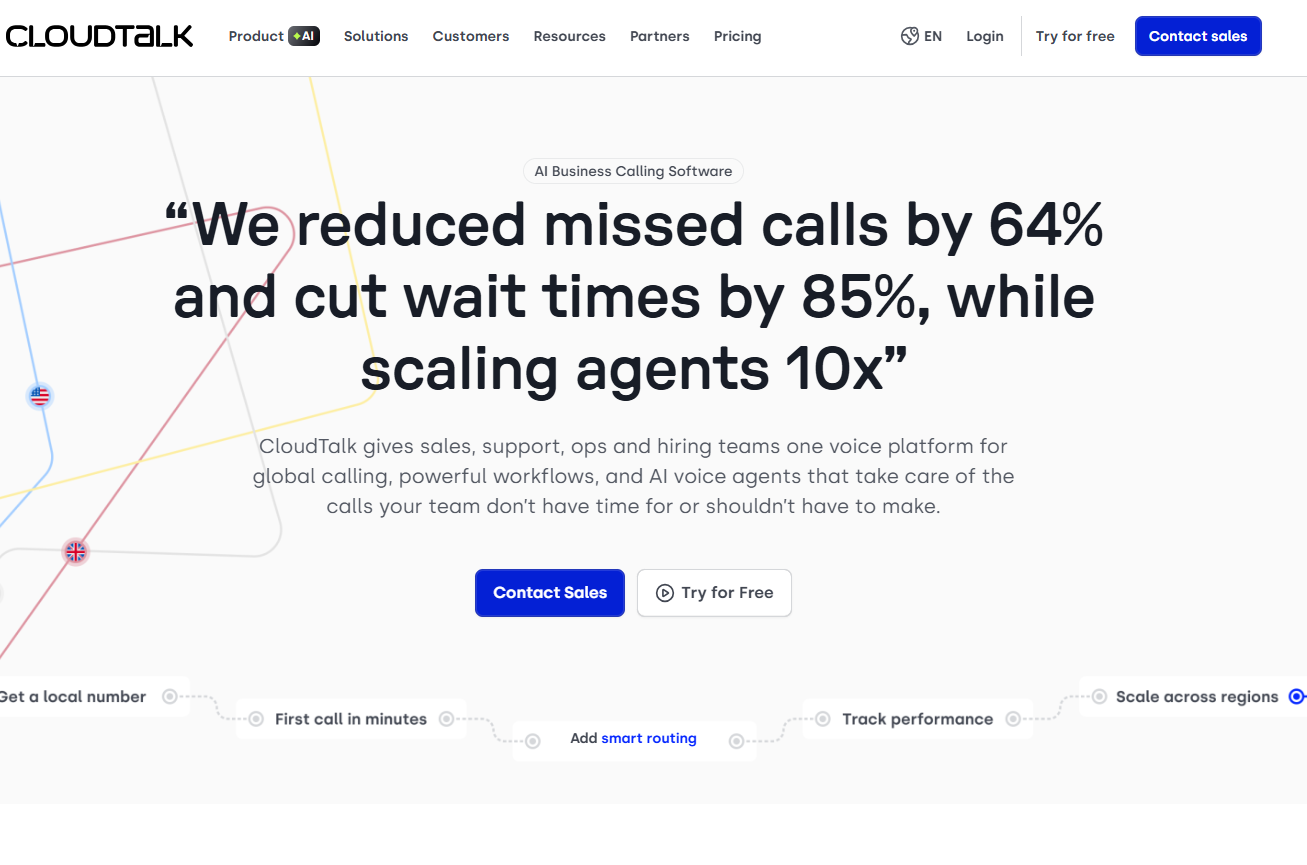
CloudTalk bundles AI voice agents with a full cloud phone system. If you need AI call handling plus basic phone features (routing, IVR, international numbers), CloudTalk packages both at a lower entry price.
Key strengths: AI agents bundled with a cloud phone system, 160+ country coverage, 99.7% uptime, and CRM integrations.
Pricing: Plans from $29/user/month.
Limitations: AI voice capabilities aren’t as advanced as dedicated platforms. It’s a phone system first, AI agent second.
Best for: Sales and support teams that need a phone system with built-in AI features.
10. Ringly.io: Best for Shopify and e-commerce
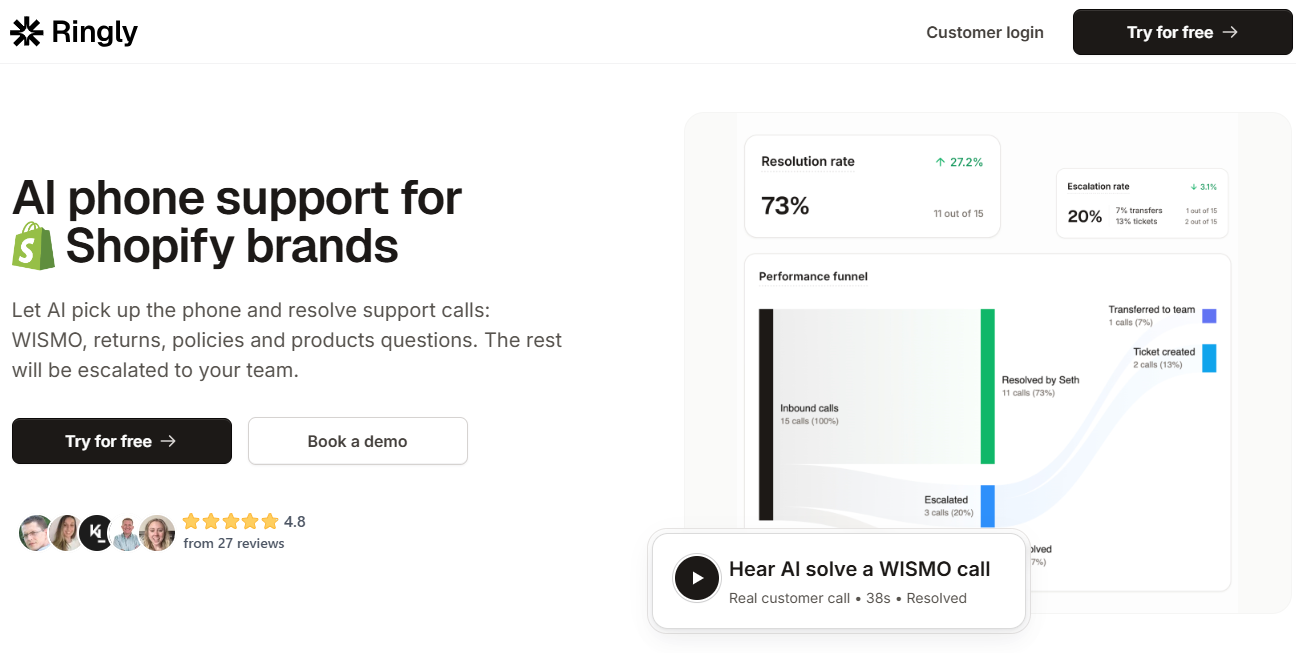
Ringly.io connects directly to Shopify, pulls order data, handles returns, and answers product questions via phone. Setup takes about 3 minutes because the integration is native.
Key strengths: Native Shopify integration (orders, returns, inventory, tracking), 40 languages, free trial with a guarantee — you pay $0 until AI hits 60% resolution rate.
Pricing: Plans from $349/month for 1,000 minutes.
Limitations: E-commerce only. If you’re not running an online store, look elsewhere.
Best for: Shopify and e-commerce businesses that need AI phone support tied to their store data.
11. Dialora: Best for lean SMBs that want AI sales reps
Dialora targets small businesses that want a focused AI voice agent for lead qualification and appointment booking. No enterprise complexity.
Key strengths: Predictable monthly pricing with included minutes, a white-label option for agencies, and a simple setup.
Pricing: Starter from $39/month (200 min). Professional $297/month (1,000 min). Business $750/month (3,000 min).
Limitations: Less customizable than developer platforms. Not for complex workflows or large contact centers.
Best for: Small businesses and agencies wanting predictable costs for lead qualification and appointment setting.
Quick comparison table
Snapshot comparison: how the developer platforms stack up
Synthflow, Vapi, and Bland AI all target technically inclined teams. Here’s how they compare on the dimensions that matter for daily operations:
Source: SquawkVoice Snapshot Comparison across all platforms (2025)
All three require technical expertise across the board. The difference lies in what you get after the call: Vapi provides the most comprehensive post-call data, Bland gives you summaries but no structured actions, and Synthflow offers the least visibility without customization. If post-call data matters to your operations, that’s worth weighing alongside price.
What to look for in a Synthflow alternative
Call quality and latency
Test with real callers, not demos. The agent should respond within 500ms, handle interruptions (barge-ins), and stay natural-sounding throughout the call. Ask about latency under load.
Pricing transparency and scalability
Can you predict your bill within 10%? Watch for stacked costs (voice, LLM, and telephony billed separately). The best platforms give a single, clear per-minute rate. Synthflow’s component model makes this hard — one of the top reasons teams leave.
Post-call visibility
This is the gap most buyers don’t think about until they’re using the platform daily. Can you see what happened on every call without listening to recordings or reading full transcripts? Structured summaries, action items, and outcome tracking save your team hours per week.
Integrations
Check for native connections with your CRM, calendar, telephony, and ticketing tools. Our evaluation noted that Synthflow’s calendar integrations are “not straightforward” and that additional subscriptions are required for some of them. Native integrations outperform webhook-only approaches in terms of maintenance and reliability.
Compliance and security
In healthcare, finance, or education, look for SOC 2, HIPAA, GDPR, and PCI DSS. Ask about data residency and PII handling.
The best Synthflow alternative for most businesses: SquawkVoice
Why does it fit most businesses
SquawkVoice answers every inbound call 24/7 with natural-sounding AI, qualifies leads, books appointments to your calendar, routes calls when human help is needed, and logs everything with recordings, transcripts, and structured outcomes.
The mobile app is a standout — SMB owners can set up and manage their AI receptionist from their phone. The web app handles complex enterprise workflows with API integrations and multi-step call flows. For businesses already on Freshworks, the native integration means no Zapier middleman.
Pricing is flat at $0.20/min, with no platform fees and 50 free calls for testing. For a dental practice handling 30 calls a day or an HVAC company fielding after-hours emergencies, the math works out to a fraction of a human receptionist. Multilingual support across 30+ languages serves diverse communities without bilingual hiring.
Based on our evaluation data, the contrast with Synthflow is stark: SquawkVoice offers production-ready agents out of the box, structured post-call summaries, call recordings across all plans, analytics tied to outcomes, and a simple UX with grouped menus. Synthflow gives you a more powerful builder, but you absorb the cost of configuration, tuning, and the post-call gaps.
Who should choose SquawkVoice?
Service businesses that rely on phone calls: dental offices and healthcare clinics, med spas, HVAC contractors, electricians, roofers, and growing SMBs with small front-desk teams.
Conclusion
Synthflow still works for agencies building custom voice agents and developer teams that want granular control over workflows. If you need outbound campaigns, white-labeling, or a full BYO stack, it’s a capable platform.
But if you’re hitting pricing ceilings, frustrated by the setup complexity, missing post-call visibility, or need something your non-technical team can manage, the alternatives here cover every use case. SquawkVoice is the best all-around upgrade for SMBs and service businesses. Retell AI and Vapi serve developer teams. Bland AI and PolyAI handle enterprise scale.
Go live with SquawkVoice in minutes
Request a Demo →
Frequently asked questions
What is the best alternative to Synthflow?
For most businesses, SquawkVoice — 24/7 AI answering, mobile app, native CRM integrations (including Freshworks), multilingual support, and $0.20/min pricing with production-ready agents. For developer teams, Retell AI starts at a base rate of $0.07/min.
Which Synthflow alternative is best for small businesses?
SquawkVoice and Dialora. SquawkVoice’s mobile app gets you live in minutes with 50 free trial calls and structured post-call data. Dialora offers predictable pricing from $39/month, with 200 minutes included.
Which Synthflow alternative has the best call quality?
Retell AI and SquawkVoice both get positive feedback on call quality. Retell reports sub-second latency with barge-in support. SquawkVoice focuses on natural conversation with full recordings and transcripts for monitoring. SquawkVoice also offers 20+ voices with accent, stability, and speed tuning.
Is there a free alternative to Synthflow?
Voiceflow has a free plan for conversation design (separate telephony needed). Retell AI gives $10 in free credits. SquawkVoice includes 50 free calls on trial.
Does Synthflow include call recordings?
No. Synthflow provides transcripts but no call recordings on the standard plan. If recordings are required for compliance or QA, look at SquawkVoice (included on all plans) or Retell AI.
What should I look for when replacing Synthflow?
Call quality under real conditions, pricing predictability at your volume, setup ease for your team’s technical level, post-call visibility (structured summaries and outcome tracking), native integrations with your CRM/calendar, and compliance certifications for your industry.