%201.svg)
%20-%20Features%2C%20Pricing%2C%20Pros%20and%20Cons.png)


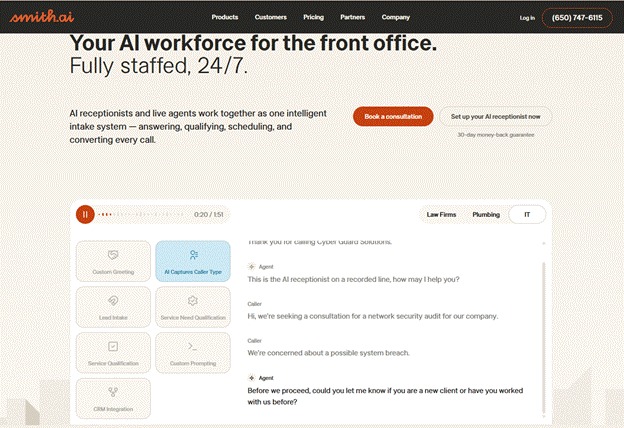
If you've searched for an answering solution for your law firm, home services company, or growing sales team, you've seen Smith.ai popping up. They promise a hybrid of AI and live North American receptionists: 24/7 call answering without hiring in-house staff.
That promise is real, partially. Smith.ai does a good job when you need a warm human voice to qualify a lead or route a call. But the model has a cost problem. Per-call billing means your monthly spend shifts based on volume you can't always predict. Overage fees of up to $11.50 per call on human-first plans stack fast. And the AI layer, while useful for basic screening, still leans heavily on human agents for anything beyond simple intake. You're paying for a hybrid, but you're often just paying for people.
This Smith.ai review breaks down what the platform actually delivers in 2026: pricing tiers, AI capabilities, integration depth, and the specific friction points users report after months of real-world usage. We tested the claims against what businesses actually experience. Where Smith.ai earns its reputation, we say so. Where it falls short, especially for teams that need scalable, autonomous call handling, we say that too.
If you're evaluating Smith.ai alongside pure AI voice agent platforms like SquawkVoice, this review provides concrete details for comparison.
How We Evaluated Smith.ai
No review is useful without a framework. We evaluated Smith.ai across five dimensions that matter most to businesses shopping for an AI-powered call answering solution:
1. Pricing transparency. We mapped every published plan, including base rates, call volumes, overage fees, and add-on costs that aren't shown on the main pricing page.
2. AI capability depth. We assessed whether the AI can handle multi-step requests autonomously, perform live data lookups during a call, and resolve conversations without human intervention, or whether it functions primarily as a routing layer before a human takes over.
3. Call handling and escalation quality. We looked at how Smith.ai manages the handoff between AI and human agents, whether callers experience dead air or repeated questions, and how context transfers between stages.
4. Integration and telephony infrastructure. We evaluated CRM connectivity, SIP trunking support, real-time backend data access during calls, and post-call automation.
5. Real user feedback. We aggregated pain points from G2, Capterra, and independent review sources. Billing surprises, scalability complaints, and feature gating came up consistently. We weighted recurring themes over one-off complaints.
Every strength and limitation in this review maps back to these five criteria.
Where Smith.ai Falls Short
Smith.ai built its reputation on reliable human receptionists with an AI assist. That's a legitimate service. But for businesses evaluating it as an AI-first call solution in 2026, the gaps are specific and measurable.
Routine calls pile up more than most businesses realize. If you haven't looked at the full cost of repetitive inbound volume, this breakdown of why routine calls are the hidden cost in customer support puts the numbers in context.
Per-Call Billing Turns Growth Into a Budget Problem
Smith.ai's pricing model charges per call, not per minute. The AI-first self-service entry plan starts at $95/month and is designed for around 2 calls per day. That sounds affordable until you do the math. A business fielding 15 calls a day blows through that tier within days. Human-first plans charge even more: overage fees start at $11.50 per call on the Starter tier.
There's no unlimited option. No usage-based per-minute pricing. Every unanswered call outside your plan limit is either lost revenue or an unexpected charge. Compare this to per-minute models like SquawkVoice at $0.09/minute at enterprise volume, where you pay only for actual conversation time, not a capped allotment that punishes you for being busy.
The AI Can't Finish What It Starts
Smith.ai markets AI-powered call handling, and the AI does work for the first 30 seconds. It screens calls, captures basic info, and routes based on simple rules. Then it hands off to a human.
That's AI-assisted triage. There's no evidence that Smith.ai's AI can handle a multi-turn conversation autonomously: checking an order status, updating an account, answering a nuanced question from a knowledge base, and confirming next steps, all in one unbroken call. The hybrid model means the AI is a front door, not a full agent.
For businesses that want AI to replace call handling labor rather than just precede it, this is a fundamental limitation. Platforms built as conversational AI agents handle pre-call CRM lookups, live data retrieval mid-call, and post-call CRM updates in a single automated lifecycle. You can read more about how full automation works in our guide to automating phone calls with AI.
Hidden Fees Gate Standard Features Behind Paywalls
Smith.ai's base plan prices tell half the story. Call recording and transcription cost an extra $0.25 per call. Appointment booking adds $1.50 per call. Text and email follow-ups add $0.50 per call. CRM integration is reserved for Professional/Pro tiers.
Stack those extras onto the 90-call Basic plan, and you're adding $225/month or more in fees on top of the $810 base fee, before overages. Users flag this repeatedly: the pricing page looks simple, but the invoice tells a different story. SMS follow-ups, integrations, and team seat access all carry additional costs that only surface during onboarding or on the first bill.
No Real-Time Data Access During Calls
A caller asks about their order status. The receptionist can't look it up. A prospect wants to confirm their appointment time. The agent checks a static script, not your scheduling system, in real time. Calls that should be one-touch resolutions become two-step processes: answer the call, then call the customer back after someone manually checks the system.
A platform with a during-call data lookup phase, one that queries your order management system, CRM, or scheduling tool while the caller is still on the line, eliminates the callback loop. Smith.ai's architecture doesn't support that workflow.
Escalation Works, but Context Doesn't Always Travel Clean
Smith.ai's escalation from AI to live agent is one of its strongest features. The handoff is generally smooth, and human agents are trained and professional. But the experience depends on your plan tier and the complexity of your configuration.
On lower-tier plans, escalation is basic: the AI flags the call, and a human picks it up. Call context may include the caller's name and stated reason, but there's no transcript of the AI interaction automatically passed to the human. On higher tiers, call recording is available for an extra fee, but a recording isn't the same as a structured summary with disposition and intent tagging.
Where Smith.ai Delivers
Smith.ai isn't all friction and hidden fees. The platform earned its reputation for a reason. If your use case fits the model, moderate call volume, high value per lead, and a genuine need for human judgment on calls, it delivers real results.
Live Receptionists Are Genuinely Good
This is Smith.ai's core advantage. The live North American receptionists are professional, responsive, and trained for specific industries. Law firms, home services companies, and healthcare practices report that callers can't tell they're speaking with an outsourced team.
The bilingual support on Basic plans and above adds genuine value for businesses serving diverse markets. And the 24/7 staffing means you never route a late-night or weekend call to voicemail.
Call Screening and Routing Work as Advertised
Smith.ai's AI layer handles frontline screening effectively. Spam calls get blocked. Callers are greeted, asked for their reason for calling, and routed according to rules you define. For simple intake, name, contact info, and service needed, the AI captures data accurately before passing it to a human agent when needed.
Setup Is Straightforward for Standard Use Cases
You don't need a developer to get started. Smith.ai's onboarding for basic call answering involves forwarding your business number and configuring a call script through their dashboard. Most businesses can go live within a day for simple screening and routing:
• Forward your number. Route calls from your existing business line to Smith.ai's assigned number.
• Set your script. Define greeting, screening questions, and routing rules through the admin panel.
• Configure integrations. Connect your CRM or calendar tool from the integrations menu.
• Go live. Calls start flowing immediately.
For a solo attorney or a three-person HVAC team, that's genuinely easy. No SIP configuration, no API work, no technical overhead. The tradeoff is that this simplicity limits what you can customize, but for the target user, it's the right balance.
Integrations Cover the Basics
Smith.ai connects to popular CRMs, including Salesforce, HubSpot, and Clio. It also integrates with Zapier, which opens the door to hundreds of downstream tools, including Slack notifications, spreadsheet logging, and email triggers.
After each call, lead data syncs automatically to your CRM. Call outcomes are logged, and follow-up tasks are generated based on your rules. Calendar integrations with Calendly, Acuity, and Google Calendar mean appointment bookings land directly in your scheduling tool.
24/7 Coverage Without Hiring
The simplest value proposition Smith.ai offers: your phone is always answered by a professional. Nights, weekends, holidays. No staffing gaps. No overtime pay. No sick days.
For a solo practitioner or a small team, this replaces an in-house receptionist at roughly one-third the cost. A full-time receptionist in the U.S. costs $32,000 to $45,000 per year in salary alone, plus benefits and overhead. Smith.ai's human-first plans range from $3,500 to $12,000 annually, depending on volume. If your call volume stays within plan limits, the math works clearly in Smith.ai's favor.
Smith.ai Pricing: The Full 2026 Breakdown
Smith.ai publishes its base pricing on its website. What it doesn't make obvious is how add-ons, overages, and tier requirements shape the real monthly cost.
AI-First Plans (Self-Service)
These plans use AI as the primary handler with human backup for escalations.
Appointment booking adds $1.50 per call. Text and email follow-ups add $0.50 per call. These apply on top of overage fees when applicable.
Human-First Plans (Live Receptionists)
These plans route calls to trained live agents with AI-assisted screening upfront.
What the Invoice Actually Looks Like
A realistic scenario: a mid-size law firm on the human-first Basic plan fields 120 calls in a month.
That's $15,660 per year, for a service where the AI handles screening and humans do the rest.
Long-Term Cost Comparison
The per-call model works at low, predictable volumes. It breaks down when your business grows, or call patterns fluctuate seasonally.
The gap widens at every tier. At 500 monthly calls, Smith.ai costs roughly 36 times as much as a per-minute agent handling the same volume.
The Hidden Cost: Admin Overhead
Smith.ai's capped plans require you to monitor your call count throughout the month. Go over your limit, and you pay overages. Stay far under, and you've overpaid for unused capacity. Either way, someone on your team is checking dashboards, adjusting call forwarding, and doing math that shouldn't be necessary.
With usage-based per-minute billing, you pay for what you use. No caps. No overages. No tracking call counts against plan limits. The billing model itself becomes a feature, or in Smith.ai's case, a recurring task.
Who Should Still Choose Smith.ai
• Low-volume, high-value intake. If you handle 30 to 60 calls per month and each converted lead is worth $5,000 or more, the per-call cost is trivial against the revenue each call represents.
• Mandatory human voice. Some industries or client segments still require a live human on every call. Smith.ai delivers that consistently.
• No technical resources. If you have zero appetite for configuring AI agents, SIP trunks, or webhook integrations, Smith.ai's managed service removes that burden entirely.
If your needs extend beyond that: growing call volume, desire for autonomous AI resolution, need for real-time data access during calls, or a requirement for predictable monthly costs, the model stops working. That's not a flaw in your business. It's a structural limitation of per-call hybrid pricing in a market that's moved to AI-first, per-minute platforms.
Still paying per call? Run the math.
See exactly what SquawkVoice costs against your actual call volume. No credit card. Request a Demo →
Smith.ai Alternatives Worth Considering
Smith.ai isn't the only option. Depending on what's pushing you to look elsewhere, different platforms solve different problems. Here's a quick map before we go deeper on the strongest alternative.
SquawkVoice: Best Overall for Growing Businesses
The most direct replacement for businesses that want AI to handle the full call, not just screen it. Usage-based pricing from $0.09/min at enterprise volume, same-day deployment, real-time backend data access, and no per-call caps. Both a web application for mid-market companies with complex call workflows and a mobile app for solopreneurs who need to manage everything from their phone. More on this below.
Ruby Receptionists: Best if You Need Live Humans
US-based receptionists, polished intake, and good training. Starts around $235/month for 50 minutes. The per-minute model is more predictable than Smith.ai's per-call structure, but costs still grow linearly with volume. No real-time data lookups. Best for professional services firms where a live human voice is genuinely non-negotiable.
Goodcall: Best Budget AI Option for Solopreneurs
Starts around $59/month. Handles basic screening, message capture, and Google Calendar scheduling. Shallow AI that handles single-turn questions well but struggles with anything multi-step. No native CRM integrations beyond Google Calendar. A good starting point if you're fielding under 20 simple calls per day and need something better than voicemail.
Dialzara: Best for Voicemail Replacement
Starts around $29/month. Picks up calls, captures messages, and sends summaries. No muand lti-step conversation handling, no real-time data lookups, no CRM integrations. A smart voicemail upgrade, nothing more. You'll outgrow it the moment your calls require anything beyond name-and-number capture.
SquawkVoice: The AI-First Alternative
SquawkVoice is a conversational AI voice agent platform built to answer inbound business calls autonomously. No live receptionists. No per-call caps. No hybrid handoffs where the AI starts and a human finishes. The AI is the agent, from the first ring to the post-call summary.
The platform replaces rigid IVR phone trees with natural, multi-turn conversations. A caller speaks normally. The AI understands intent, asks follow-up questions, queries your backend systems in real time, and resolves the request, or escalates with full context when human judgment is genuinely needed.
SquawkVoice runs on two product lines. The web application is built for mid-market companies that need custom workflows, deep CRM integrations, and call deflection at scale. The mobile app is built for solopreneurs and small business owners who want something they can set up in five minutes and manage entirely from their phone, without a front desk or technical skills. Both products use per-minute usage-based pricing. You pay for actual conversation time. No bundled call allotments. No overage penalties.
SquawkVoice Pricing
Included at every tier:
• Full call transcription, no per-call fee
• Post-call summaries with intent tagging
• CRM sync and webhook integrations (Salesforce, HubSpot, Freshworks, Zendesk)
• No-code Agent Builder
• Knowledge base support with large file uploads
• SOC 2 compliant, GDPR-ready infrastructure
No hidden add-ons. No feature gating behind higher tiers. The difference between plans is volume commitment, not capability.
What Makes SquawkVoice Different
The Full Call Lifecycle, Not Just the Handoff
Every SquawkVoice call follows a structured process covering pre-call, during-call, and post-call, each with HTTPS action hooks that connect to your systems.
Smith.ai's architecture supports post-call data pushes, but the pre-call and during-call phases don't exist. There's no live data retrieval. No pre-call context loading. The AI layer screens, the human handles, and the system logs afterward. That's one phase out of three.
AI-Resolved Escalation
When a SquawkVoice call genuinely requires a human, the escalation is intelligent. The human who picks up has complete context. No cold transfer. No 'can you repeat your issue?'
Smith.ai's human handoff works, but it's a simpler pass-through. Lower-tier plans don't include transcripts or structured context with the transfer. The result: callers repeat themselves, and agents start from zero. It's better than an IVR, but it's not intelligent routing.
For a full comparison of what an AI receptionist and a virtual human receptionist can do, the guide walks through the capabilities and costs of both models.
No-Code Agent Builder
SquawkVoice includes a visual Agent Builder that lets you design call flows, set routing logic, define escalation rules, and configure knowledge base responses, all without writing code. You map out how your AI agent should behave: what questions it asks, what data it retrieves, how it responds to specific intents, and when it escalates. Changes deploy immediately.
Smith.ai's setup is straightforward for basic scripts, but customization beyond simple call handling requires coordination with their team. Complex workflows with trained human agents take time. With SquawkVoice, you build, test, and deploy the same day.
Smith.ai vs. SquawkVoice: Which Offers Better Value?
Making the Right Choice for Your Business
Smith.ai earned its place in the market by solving a real problem: small businesses need their phones answered professionally without hiring full-time staff. That problem hasn't disappeared. But the best solution to it has changed.
In 2026, AI voice agents will handle conversations that Smith.ai still routes to humans. They resolve calls that Smith.ai's AI only screens. They pull live data during calls that Smith.ai's architecture can't access until after the caller hangs up. And they do it at a fraction of the per-call cost, with no caps, no overage fees, and no hidden add-ons.
The practical test is simple. Take your last three months of call data. Count your total calls. Multiply by your average call duration. Calculate what you'd pay on Smith.ai's current plan, including overages, transcription fees, appointment booking charges, and follow-up costs. Then multiply your total minutes by $0.20, or $0.09 at enterprise volume. The number that comes back will tell you everything this review just did.
If you're ready to see what autonomous AI call handling looks like, with real-time data access, intelligent escalation, and billing that doesn't punish you for growing, the next step takes five minutes.
Want to See What Your Bill Could Look Like?
Bring your call volume. We'll show you SquawkVoice handling your actual call types and what it costs.
Frequently Asked Questions
Is Smith.ai worth it for a small law firm?
It depends on your call volume. If you handle 30 to 60 calls per month and each new client is worth $5,000 or more, Smith.ai's per-call cost is manageable against the revenue each lead generates. Once you consistently exceed your plan limit, the math changes fast. Firms reporting $800 to $1,600 per month in total spend are typically fielding 100 to 200 calls, a volume range where per-minute AI platforms cost a fraction of what Smith.ai charges.
Can Smith.ai's AI handle calls without a human?
For basic tasks, yes. The AI screens calls, captures caller information, and books simple appointments. For multi-step requests, nuanced questions, or anything requiring real-time data lookups, the AI hands off to a live receptionist. It's AI-assisted call answering, not fully autonomous AI call resolution.
What are the hidden fees with Smith.ai?
Call transcription costs $0.25 per call. Appointment booking adds $1.50 per call. Text and email follow-ups cost $0.50 per call. CRM integration requires a Professional or Pro-tier plan. These fees apply on top of your base plan and any overage charges. A 120-call month with all add-ons active can produce a $1,300-plus invoice on a plan that starts at $810.
How does per-call pricing compare to per-minute pricing?
Per-call pricing charges the same rate whether a call lasts 30 seconds or 15 minutes. Per-minute pricing charges only for actual conversation time. At Smith.ai's $11.50/call overage rate on human-first plans, a 2-minute call costs $11.50. On a per-minute platform at $0.20/minute, that same call costs $0.40. The gap compounds with every call, every day.
Does SquawkVoice work with my existing phone system?
Yes. SquawkVoice supports enterprise SIP trunking with TLS and SRTP encryption, enabling direct integration with your existing telephony infrastructure. You can also forward calls from your current business number. Setup takes the same day, no multi-week onboarding process.
Can I switch from Smith.ai to SquawkVoice without losing call coverage?
You can. SquawkVoice deploys same-day. Configure your AI agent in the no-code Agent Builder, upload your knowledge base, connect your CRM, and route your business number. You can run both platforms in parallel during the transition and cut over once you've confirmed the AI handles your call types correctly. No contract lock-in. No credit card required to start.
Related posts
View All
.png)

Subscribe to our newsletter
Your next customer is calling. Are you answering?

.png)