%201.svg)


.png)


It’s 2026, and most businesses have already automated a large chunk of their functions. Invoices go out automatically. Reminders get sent automatically. Tickets get tagged and routed automatically. Even website chats are automated.
Then the phone rings, and suddenly it’s 2009 again. A human has to pick up, ask the same questions, repeat the same answers, and manually do the same admin work. Or worse, nobody answers, and the caller disappears.
That’s why automating phone calls with AI has become such a practical topic. Not because it’s cool to have an AI voice. Because the phone is still one of the highest-intent channels businesses have, and it’s often the least operationally efficient.
When Do Businesses Need Automated Phone Calling?
Most businesses reach a point where the volume and variety of inbound calls begin to work against them. The phone is one of the few remaining channels with no systematic way to handle scale, and the operational consequences show up quickly.
The gap between where the industry is heading and where most businesses currently operate is significant. McKinsey's research projects that AI will unlock up to 60% of addressable care volume for organizations that deploy it fully. Leading companies have already begun reversing inbound volume growth through self-service and digital deflection. Yet in many small and mid-market businesses, that number is still high.
The signs that your business has outgrown manual call handling tend to follow a pattern:
- Your team answers the same ten questions all day. Hours, pricing, appointment availability, order status, service areas. These questions do not require judgment, but they consume significant staff time.
- Call volume spikes are a recurring crisis. Peak periods, marketing campaigns, or seasonal demand leave you either understaffed and creating poor customer experiences, or overstaffed and carrying unnecessary costs outside those windows.
- After-hours calls go unanswered by default. A caller outside business hours who cannot reach you will move on. There is no mechanism to capture that intent.
- You have no data on what your callers actually want. You cannot see call volume by topic, peak hours, or unresolved queries. Decisions about staffing and service design are made on instinct rather than evidence.
- Agents are handling calls that do not require them. Complex issues sit in the queue while experienced staff spend their time on basic information requests.
The urgency of solving this is growing. McKinsey's analysis of European customer operations executives found that 35% of organizations plan to automate over 60% of their inbound inquiries by 2028, and 62% expect authentication and call summaries to be handled entirely by AI eventually. The organizations moving now are widening a gap that will be difficult to close later.
Benefits of Automating Business Calls with AI Voice Agents?
The business case for AI phone agents is built on four concrete outcomes: availability, cost structure, consistency, and operational data.
24/7 Coverage Without Shift Premiums
An AI phone agent answers on the first ring at 11 pm on a Sunday, just as it does at 10 am on a Wednesday. For small businesses, this means capturing after-hours inquiries that would otherwise be lost. For companies with contact centers, it absorbs overflow and out-of-hours volume without adding headcount or scheduling complexity.
Measurable Cost Reduction
A Gartner survey found that 55% of organizations report stable staffing levels while handling higher customer volumes, pointing to AI as the driver of efficiency gains rather than headcount cuts. Separately, McKinsey's analysis of contact center transformation found that AI agents are already halving the cost per call while improving customer satisfaction scores. These productivity gains compound across every call handled.
Agents Working on the Right Things
Deloitte's 2026 State of AI in the Enterprise report found that agentic AI is expected to have the highest business impact in customer support, ahead of supply chain, R&D, and cybersecurity. Worker access to AI rose 50% in 2025, and the number of organizations with 40% or more of their AI projects in production is set to double in the next six months.
That gap between the front-runners and the rest is widening. The businesses that automate routine call handling now are freeing their best people to work on calls that actually need them.
Consistent Experience on Every Call
The quality of a human interaction varies with mood, fatigue, and experience level. An AI agent delivers the same accuracy, tone, and speed on every call. For businesses where brand experience matters, this consistency is not a minor detail. It is the baseline.
A Data Layer That Did Not Exist Before
Manual call handling produces almost no structured data. An AI phone agent produces full transcripts, caller intent categories, resolution outcomes, and escalation records for every call. Over time, this data shows you what your customers are actually asking, where they are dropping off, and what is driving inbound volume. It turns your phone line into a source of business intelligence.
How to Automate Phone Calls With AI: Step-by-step
The implementation path varies depending on your business size and the complexity of your existing systems.
For Small Businesses (Mobile-first Setup)
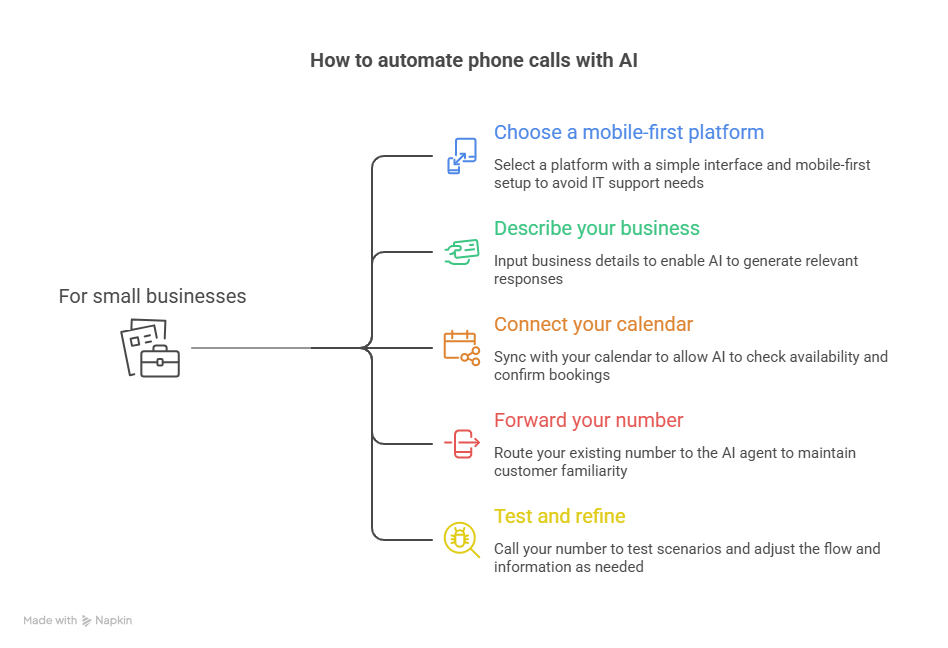
- Choose a platform built for small businesses: Look for a mobile-first setup, built-in appointment booking, and a simple interface that does not require IT support. If onboarding requires a technical team, it is not the right product for a solo operator or a small team.
- Describe your business: Input your services, pricing, hours, and service area. Modern AI phone platforms use this information to generate contextually relevant responses without you writing scripts line by line.
- Connect your calendar: Sync with Google Calendar, Outlook, or the platform's built-in calendar so the AI can check real availability and confirm bookings during the call, without any back-and-forth.
- Forward your number: Route your existing business number to the AI agent. Every incoming call automatically passes through it. No change in the number that your customers already have.
- Test and refine: Call your own number and run through your most common scenarios. Adjust any information that comes out wrong. Most platforms let you update business details from your phone in minutes.
For Mid-Market Companies (Web App/Enterprise Setup)
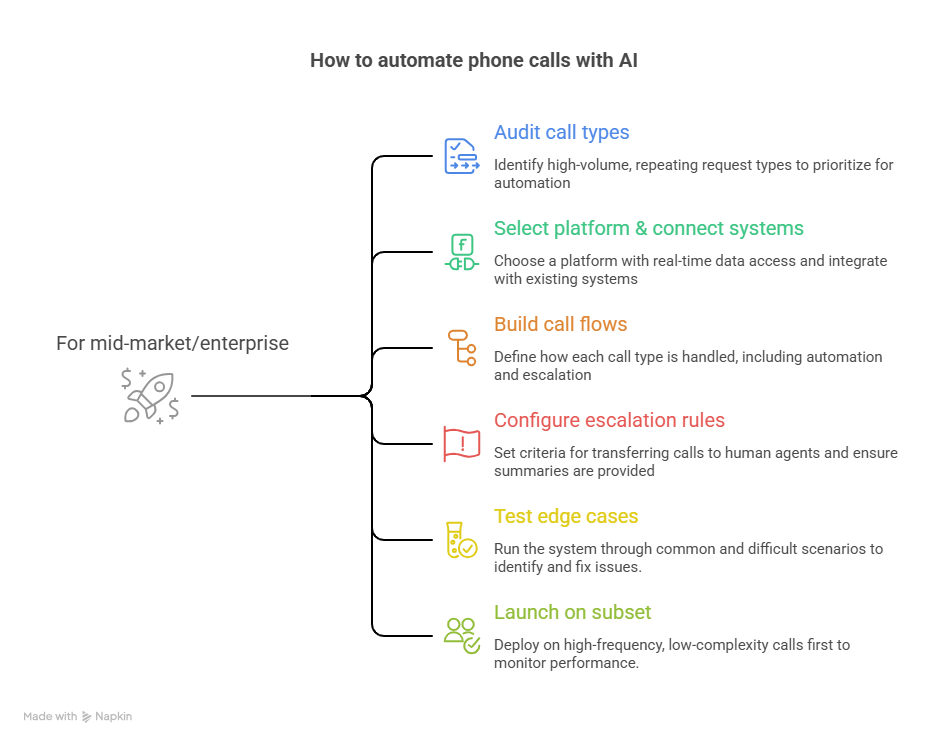
- Audit your call types first: Pull 30 days of call data and categorize why people are calling. You will almost always find that 40-60% of volume falls into a short list of repeating request types: order status, appointment booking, basic FAQs, and billing inquiries. These are the calls to automate first.
- Select a platform and connect your systems: The capability that separates a useful AI phone agent from a sophisticated voicemail is real-time data access. Your platform should integrate with your CRM (Salesforce, HubSpot), order management system, scheduling tools, and knowledge base. Integration enables the AI to answer questions with actual data rather than pre-written responses.
- Build your call flows: Use the platform's workflow builder to define how each call type is handled, what gets resolved automatically, what triggers escalation, and what data should be pulled from which system. Define these paths before going live.
- Configure escalation rules: Set criteria for when a call transfers to a human agent, including caller sentiment, topic complexity, customer tier, or specific triggers. The AI should pass a complete conversation summary when it hands off. The agent should know exactly why the call is being transferred before they say hello.
- Test your edge cases, not just your best cases: Run the system through your most common call types and your most difficult scenarios. Adjust response logic, add missing content to your knowledge base, and verify that integrations are returning accurate data before going live at scale.
- Launch on a subset of volume first: Deploy on your highest-frequency, lowest-complexity call types. Monitor deflection rate, escalation rate, and customer satisfaction before expanding the scope.
Key Features of Automated Phone Calling
Not all AI phone platforms deliver the same results. These are the features that determine whether a system genuinely moves the needle.
Natural Language Processing with Sub-second Response
The AI needs to understand how people actually talk, including incomplete sentences, accents, and background noise. Response speed matters just as much as accuracy. The conversational feel of an AI interaction breaks down when there is a noticeable pause between the caller's question and the agent's reply. Modern platforms respond in under a second.
Real-time System Integration
An AI phone agent limited to scripted answers is not materially better than an IVR. The most important capability in any platform is real-time data access during the call. McKinsey's March 2025 contact center research estimates that AI-driven automation can enable organizations to handle 20-30% more calls with 40-50% fewer agents, but only where integration is deep enough for the AI to pull live data rather than default to static responses. When a customer asks where their order is, the AI should provide live tracking data, not suggest checking their email.
Answering Frequently Asked Question
An AI phone agent is equipped to handle the most common questions callers ask on a daily basis, without ever needing to put someone on hold or transfer them to a human. This includes straightforward inquiries like business hours, location details, and services offered, as well as more dynamic requests such as order status updates, delivery tracking, and account information — all pulled from live data in real time. For businesses that run on appointments, the AI can check availability, confirm bookings, and send text confirmations instantly. It can also walk callers through basic troubleshooting steps, explain pricing or policy details, and answer product-related questions. Because the system uses natural language processing, it understands how people actually speak rather than requiring callers to navigate rigid menu options, making it capable of handling a much broader and more conversational range of questions than traditional phone systems ever could.
Appointment Booking With Live Calendar Sync
For any business that runs on bookings, this is non-negotiable. The AI should check real availability during the call, confirm the appointment directly, send the customer a text confirmation, and update the calendar without any manual intervention.
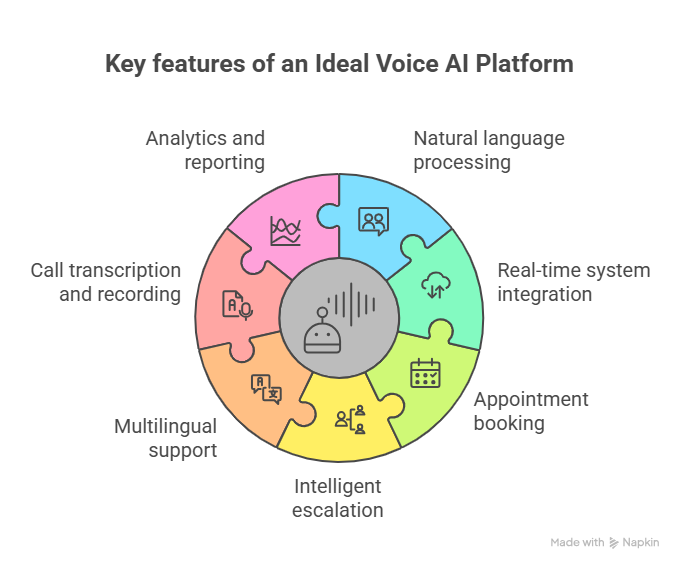
Intelligent Escalation With Full Context
A well-designed AI phone agent knows what it cannot handle. When it transfers a call, the receiving agent should already have the caller's name, what they asked, what the AI accessed or tried, and why the call is escalating. No re-introductions, no repeated explanations for the customer.
Multilingual Support
For businesses operating in diverse communities or across markets, multilingual handling without additional staffing is a genuine operational advantage. The AI detects the caller's preferred language and responds in it.
Full Call Transcription and Recording
Every call should produce a complete text transcript and an audio recording. These records support quality review, compliance, staff training, and the kind of structural analysis that shows you what your customers are actually asking about.
Analytics and Reporting
You should know your AI's deflection rate, resolution rate, escalation triggers, and peak call windows, by topic and over time. If a platform does not provide this visibility, you cannot optimize it or defend the investment internally.
Why AI Phone Calling Is the Future of Call Centers
The trajectory of adoption is not ambiguous. Gartner's research predicts that by 2029, agentic AI will autonomously resolve 80% of common customer service issues without human intervention, resulting in a 30% reduction in operational costs. And in a December 2024 survey of 187 customer service leaders, Gartner found that 85% planned to explore or pilot a customer-facing conversational GenAI solution in 2025.
What often gets misread as a threat to phone communication is actually an argument for it. McKinsey's contact center research found that 71% of Gen Z respondents believe live calls are the quickest and easiest way to reach customer care and explain their issues. Meanwhile, McKinsey's report notes that some organizations are already automating up to 70% of customer contact. Phone is not declining. The way calls are handled is changing, and rapidly.
The structural shift happening now is about separating calls that require human judgment from those that do not and routing each appropriately. Businesses that automate routine call handling are freeing their teams to deliver better service on the calls that genuinely need them.
The data gap between early movers and the rest is already visible. McKinsey's research found that 40% of customer care leaders reported significantly improved customer experience scores over the past 12 months, compared with just 12% of laggards. Nine in ten leading organizations are already scaling AI across core workflows. The gap between those who treat AI as an operating-model transformation and those applying it as a point tool is starting to show in the numbers.
Now is the Time to Automate
Deploying AI phone automation used to mean months of custom development and a significant IT commitment. That is no longer the case. Small businesses can be live in minutes. Companies with complex system integrations typically go from scoping to deployment in days to weeks.
The practical question is not whether AI phone automation works. Research from Gartner, McKinsey, and Deloitte consistently points in the same direction: organizations that deploy it see measurable improvements in cost, capacity, and customer experience. The question is whether your business gets ahead of it or responds to it once competitors already have.
Every business that runs on phone calls faces the same problem. Routine, repetitive calls consume the time and energy of the people best positioned to handle complex ones. AI phone automation solves that allocation problem cleanly, at a cost that is a fraction of the staffing alternative.
If your business runs on calls, the setup is simpler than ever. The better question is: what is it costing you to wait?
Want to see AI phone automation in action?
SquawkVoice answers every call, books appointments, and automatically captures leads.
Book Demo →
Frequently Asked Questions
What are AI phone calling platforms?
AI phone calling platforms are software systems that use natural language processing and voice AI to handle telephone conversations automatically. They can answer inbound calls, respond to customer questions, book appointments, retrieve live account or order information, and escalate complex situations to human agents with full context.
Can I get AI to make phone calls?
Yes. AI agents can both receive inbound calls and initiate outbound ones. Common outbound use cases include appointment reminders, payment follow-ups, and customer check-ins.
How can I get started with AI phone automation?
If you’re a small company, choose a platform, describe your business, connect your calendar, forward your number, and test. For companies with existing systems, automation means connecting the AI to your CRM, order management system, and knowledge base, then defining call flow logic. The AI automatically handles calls according to those rules, passing anything it cannot resolve to a human agent with full context.
How does Google AI work for phone calls?
Google developed voice AI capabilities through Google Duplex, which can make calls on a user's behalf for tasks such as restaurant reservations and appointment scheduling. Google's speech and natural language processing APIs are foundational tools that enterprise developers use as building blocks.
What types of calls can AI agents handle?
AI phone agents handle high-volume, routine call types most effectively: FAQs about hours, pricing, and availability; appointment booking and rescheduling; order status lookups via your OMS; lead capture and qualification; payment inquiries; and multi-step troubleshooting flows.
Are AI robocalls illegal?
It depends on how they are used. In February 2024, the FCC issued a Declaratory Ruling confirming that AI-generated voices are classified as 'artificial or prerecorded voice' under the TCPA. This means AI-generated outbound calls are subject to the same consent requirements that have always applied to automated calling. Outbound AI calls with proper prior express consent are legal. Calls made without consent to numbers on the Do Not Call Registry are not. Inbound AI agents, which receive calls to your business number, face far fewer restrictions because the customer is initiating contact. Businesses running outbound AI campaigns should also monitor state-level rules: Texas, for example, requires an upfront disclosure that AI is being used on the call.