%201.svg)


.png)


Goodcall overview
Goodcall is a cloud-based AI phone assistant that answers inbound calls, captures leads, responds to FAQs, and handles basic appointment requests. It was built in the Google ecosystem, uses GPT-powered agents, and targets solopreneurs, micro-businesses, and small service companies.
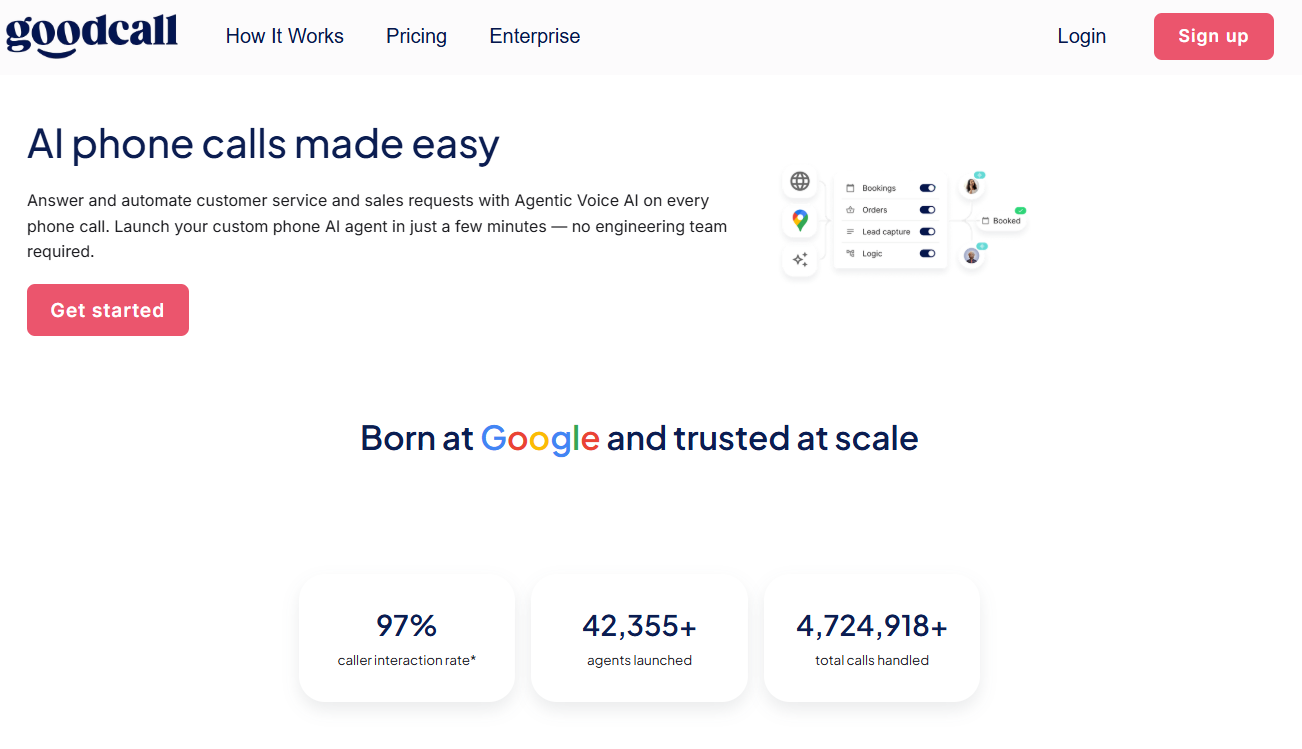
Caption: Goodcall, an AI-driven phone assistant that can take calls for your business
Alt text: Goodcall home page
The platform's defining characteristic is its pricing model: you pay per unique caller rather than per minute. A customer who calls you 10 times in a month counts as 1 call. A 30-minute call costs the same as a 30-second call. For businesses with repeat callers and longer conversations, this is a real cost advantage.
The typical Goodcall user is a solo electrician, a small salon owner, or an independent repair shop. Someone who needs the phone answered while they're working and doesn't want to think about per-minute charges.
Our competitor evaluation confirmed that Goodcall is built for autonomous resolution and does handle end-to-end calls without human agents. But the platform's pricing flexibility was rated as a weakness: tiered subscription pricing based on unique customer leads, with no usage-based option.
Goodcall pricing plans and what you get
Plan summary
What counts as a "unique caller"
A unique caller is any phone number that calls and actually interacts with the AI (says something, rather than just hanging up) in a given month. Repeated calls from the same number count as a single unique caller. Robocalls, blocked numbers, and hang-ups before interaction are excluded.
The catch: if a customer calls from a different phone number (e.g., a work phone vs. a mobile), they count as two unique callers.
Per-agent pricing and what it means at scale
Goodcall charges per agent. If you run 3 locations, each needing its own AI receptionist, you're paying for 3 agents.
At 5 agents on the Scale plan, that's $1,245/month before any overages. At that spend level, per-minute platforms like SquawkVoice offer comparable or better value without caller caps and without per-agent multiplication.
Hidden costs and gotchas
Overages add up quietly. $0.50/caller sounds small until you hit 50 overages in a month. That's $25 extra on top of your subscription. For seasonal businesses (HVAC in summer, roofers after storms), overages are almost guaranteed.
Per-agent billing multiplies fast. Multi-location businesses need multiple agents. The pricing that looks affordable for a solo operator becomes expensive at scale.
Call forwarding, not porting. Goodcall gives you a new number. If your existing number is established with customers, you set up call forwarding, not a true port. This is a workaround, not a solution. Our evaluation noted that Goodcall's deployment model requires an existing phone system, unlike standalone platforms.
Zapier is the only integration path. No native CRM connections. Zapier adds its own subscription cost ($20–$100+/month, depending on usage) and introduces latency.
Short data retention on lower plans. Starter gives you 7 days of call history. If you don't check in regularly, you lose data.
No actionable post-call summaries. Goodcall provides transcripts and consent-based recordings, but no structured summaries or actions. Your team has to review every transcript to extract outcomes manually.
SquawkVoice overview (For comparison)
SquawkVoice is an AI voice agent platform that answers business calls, handles routine inquiries, books appointments, manages order status, and escalates complex issues with full conversation context.
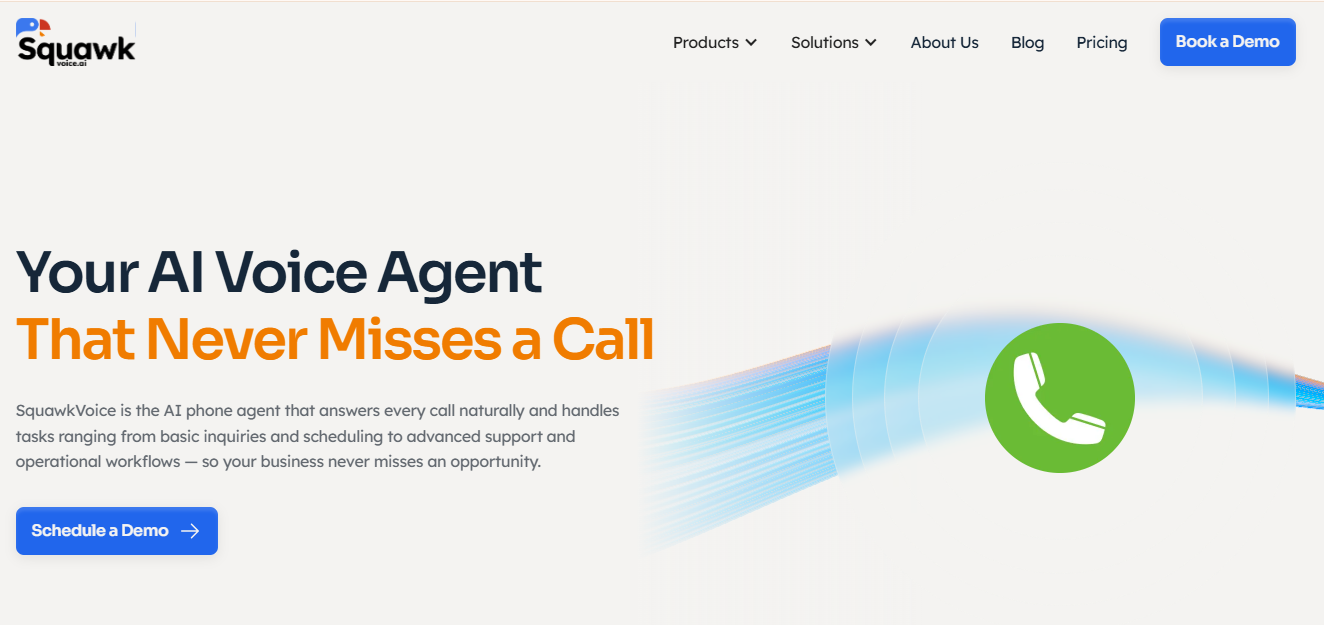
Caption: SquawkVoice can answer calls for your business, resolve routine issues, book appointments, and escalate complex issues to human agents with full context.
Alt text: SquawkVoice home page
It ships as two products. The MobileApp is built for small business owners (an HVAC tech, a dentist, an electrician) who need an AI receptionist they can set up from their phone in minutes. The WebApp handles more complex workflows for mid-market teams with backend integrations, API lookups to CRMs and ticketing systems, and analytics.
Where Goodcall caps your callers, SquawkVoice charges per minute with no caps on how many different people can call you. The rate is the rate: no component math, no overage surprises.
SquawkVoice pricing (for comparison)
No penalty rates for overages. Unused minutes roll over. Standard plans are annual with mid-year upgrade options.
Side-by-side comparison: Goodcall vs. SquawkVoice
Goodcall vs. SquawkVoice: which has better pricing?
For an accurate comparison, it’s always best to look beyond just the headline price.
Best for repeat callers with long conversations
Goodcall. If you have 80 unique callers per month and many of them spend 10+ minutes on the phone, Goodcall's unlimited minutes model is cheaper. A dental office with a loyal patient base calling for appointments and follow-ups would pay $79/month flat on Goodcall's Starter plan versus potentially $200+ on per-minute pricing.
Best for growing businesses with high caller diversity
SquawkVoice. If your marketing is driving new inbound leads (each with a different phone number), Goodcall's per-caller model works against you. An HVAC company running Google Ads might get 300 unique callers in a month. On Goodcall Growth, that's 50 overages ($25 extra). On SquawkVoice, you pay only for the minutes you use.
Best for multi-location businesses
SquawkVoice. Goodcall's per-agent pricing means 5 locations on the Growth plan costs $645/month before overages. SquawkVoice charges per minute across all locations with no per-agent multiplication.
Cost comparison at different volumes
Goodcall wins when the caller count is low and the call duration is high. SquawkVoice wins when caller diversity is high, and call duration is moderate, which describes most growing service businesses running any form of advertising.
Beyond pricing: what you actually get for the money
Price per call is only part of the equation. What happens after the call matters just as much, and this is where the value gap between the two platforms shows up.
From our head-to-head evaluation:
How to choose the right plan
If you're a solopreneur with a small, loyal customer base
Goodcall Starter at $79/month is hard to beat for this use case. Unlimited minutes, simple setup, and predictable costs when your caller count stays under 100. The single logic flow handles basic answering needs.
If you're a growing business running marketing
SquawkVoice Growth at $0.20/min. No caller caps means your marketing campaigns can drive as many new leads as possible without triggering overage fees. The mobile app lets you manage everything on the go, and you get structured post-call summaries your team can act on without manually reviewing every transcript.
If you're a multi-location operation
SquawkVoice Pro or Enterprise. Per-minute pricing doesn't multiply by location. Five locations share the same rate structure. Compare that to Goodcall, where 5 Growth agents cost $645/month.
If you serve multilingual communities
SquawkVoice. 30+ languages versus Goodcall's approximately 7. For dental practices, med spas, or HVAC companies in diverse markets, this isn't a nice-to-have; it's how you serve your actual customer base.
What’s best for your business?
Goodcall's pricing model is smart for what it optimizes: businesses with repeat callers who want zero per-minute anxiety. If you have 80 loyal customers who call regularly and spend a long time on the phone, the unlimited minutes are a real advantage.
Where the model breaks is growth, new callers cost $0.50 each beyond your cap. Multi-location businesses stack per-agent fees. The Zapier-only integrations, limited languages, dated voice quality, and missing post-call summaries push growing businesses toward alternatives sooner than expected.
SquawkVoice's flat per-minute pricing removes the growth penalty. You pay for what you use, and the rate doesn't change based on how many different people call you. For most service businesses actively trying to grow their inbound call volume, that's the more sustainable model.
Frequently asked questions
Does Goodcall have a free plan?
No permanent free plan. A 14-day free trial is available on all tiers. After that, plans start at $79/month (Starter).
What happens if I exceed Goodcall's unique caller limit?
You're charged $0.50 per additional unique caller beyond your plan's cap. On the Starter plan (100 callers), 150 unique callers in a month adds $25 to your bill.
How does SquawkVoice's pricing compare to Goodcall's?
SquawkVoice charges $0.20/min with no caller caps or per-agent fees. Goodcall charges $79–$249/agent/month with caller limits. Goodcall is cheaper for low caller counts with long calls. SquawkVoice is cheaper and more predictable for growing businesses with diverse callers.
Which is better for HVAC and home service businesses?
SquawkVoice. Seasonal call spikes are the norm in home services. Goodcall's caller caps create overages exactly when you're busiest. SquawkVoice's per-minute model with no caps handles volume surges without surprises. Plus, the 30+ language support and native integrations (including Freshworks) meet the operational needs of home service teams.
Can I keep my existing phone number with Goodcall?
Not directly. Goodcall assigns you a new number. To keep your existing number, you set up conditional call forwarding. Our evaluation noted that Goodcall requires an existing phone system for deployment, unlike standalone platforms like SquawkVoice.