%201.svg)
.png)

.png)


For decades, businesses solved their customer support problem the same way: hire more people. More calls coming in? Add headcount. Peak season? Bring in temps. The math was always simple: double the volume, double the team, double the costs.
Then came the first wave of solutions. Phone trees or IVRs that turned a two-minute question into a five-minute maze. Chatbots came after IVRs, but fell apart the moment a conversation went off-script. Each one promised efficiency, but delivered frustration.
Cut to 2026: Modern voice AI holds natural conversations, accesses real business data in real time, and knows when to hand things off to a human with full context.
McKinsey's research on agentic AI identifies customer service as one of the highest-impact vertical use cases for AI. The kind that moves the bottom line, not just the productivity dashboard. This guide covers what AI voice agents are, where they deliver real ROI, and how to choose the right one for your business.
What Is an AI Voice Agent?
An AI voice agent is software that conducts real-time voice conversations with callers, performs tasks, and resolves issues without human intervention. It can answer a question, book an appointment, or route the call to the right person.
Several technologies work together under the hood to make this happen:
- Automatic Speech Recognition (ASR) converts the caller's speech into text.
- Natural Language Processing (NLP) interprets meaning, intent, and context from that text.
- Large Language Model (LLM) generates a contextually appropriate response.
- Text-to-Speech (TTS) converts the response back into natural-sounding audio.

The entire loop occurs in under a second on modern platforms, which makes the conversation feel fluid.
The critical difference from earlier automation: these systems understand context, not just commands. When someone says, "I need to move my Thursday appointment to sometime next week," the agent understands, checks the calendar, and offers available slots.
Pros and Cons of AI Voice Agents
AI voice agents are at their best when they can reliably answer routine questions and complete simple actions. They struggle when calls become emotional, ambiguous, or dependent on messy back-end systems. Here’s the trade-off in one view.
Top 5 Use Cases for AI Voice Agents
Let’s use examples to take a look at how you can use AI voice agents across industries and use cases.
1. Customer support and FAQ handling
A customer calls their internet provider at 11 pm because their Wi-Fi stopped working during a hectic day. Instead of voicemail or a phone tree, an AI voice agent pulls up their account, runs a remote diagnostic, and walks them through a router reset in under two minutes.
This is the most common entry point for voice AI: order status, return policies, and troubleshooting. These are the calls that consume 60–70% of a support team's day and are resolved in seconds when the AI can access connected systems.
2. Appointment scheduling
A patient calls a dental clinic on a Saturday to reschedule a Monday appointment. The AI voice agent checks live availability, offers three alternative slots, books the appointment, and sends a confirmation text without a receptionist lifting a finger.
This use case is a natural fit for healthcare clinics, salons, law firms, and home services where calendar management consumes significant staff hours.
3. Lead capture and qualification
A homeowner searches "emergency plumber near me" at 6 am and calls the first result. No one answers, and it goes to voicemail. They hang up and call the next listing. If you’re the voicemail business, that's a lost job worth $100–$300.
Now imagine an AI voice agent answers instantly, captures the issue details, asks qualifying questions (location, urgency, budget), and routes the warm lead to the right technician with full context. For any service business, this is where voice agents drive direct revenue.
4. Inbound call routing and triage
A caller dials a multi-location law firm but isn't sure which department handles their issue. The AI asks a few clarifying questions, identifies the intent (estate planning, personal injury, corporate law), and transfers the summary to the appropriate attorney's office. Complex calls reach the right human faster, and no one wastes time on misrouted transfers.
5. Outbound engagement
A med spa has 47 clients due for follow-up appointments this week. Instead of a receptionist spending half a day on the phone, an AI voice agent handles the outreach. Appointment reminders, follow-ups, payment reminders, and satisfaction check-ins. These are all done at scale, in a fraction of the time, with consistent messaging each time.
Key Features of AI Voice Agents
When evaluating platforms, these capabilities separate real solutions from impressive demos.
- Low-latency natural language understanding is essential. The agent needs to handle incomplete sentences, interruptions, and accents with sub-second responses.
- Real-time system integrations let the agent access your CRM, scheduling, and order management to pull live data during calls.
- Intelligent escalation with full context ensures human agents pick up informed, not blind.
- Multilingual support, analytics and reporting, and call transcription round out the core feature set.
AI Voice Agent vs. Traditional Systems
ROI of AI Voice Agents
As we discussed before, Gartner predicts that agentic AI will autonomously resolve 80% of common customer service issues by 2029, delivering a 30% reduction in operational costs across industries.
The companies capturing that value are the ones that have moved from pilot to production, embedded it into core workflows, and let it compound savings month over month.
Here's what the math looks like for a mid-sized support team:
- Human cost baseline: A full-time customer service agent in the U.S. costs $35,000–50,000 annually, including benefits and training (Bureau of Labor Statistics). With human-handled interactions averaging $7.16, a team handling 3,000 calls per month can easily spend $15,000–36,000/month on call handling alone.
- AI cost at 40% automation: Automating 40% of those calls at $0.75/minute (3-minute average call duration) costs roughly $2,700/month and provides 24/7 coverage, zero wait times during peak periods, and consistent lead capture that previously went to voicemail.
When you’re trying to make the case for AI voice agents in your organizaton, start with the top 2–3 call types that are high-volume and repeatable (status checks, scheduling, order updates), wire the agent into the systems that complete the job, and track metrics like containment rate and cost per resolution, and you’ll have your answers on ROI.
How are AI Voice Agents Different from Traditional Systems?
Traditional systems were built around routing and containment: get the caller to the right queue, deflect what you can, and hope they don't hang up.
AI voice agents are built around resolution: understand what the caller needs, take action in real time, and escalate intelligently when necessary. To understand the gap, it helps to look at what modern voice AI actually brings to the table, and how it stacks up against the systems many businesses still run.
Best 5 AI Voice Agents for 2026
What separates the top-tier AI voice agents from the rest comes down to three things:
- How naturally and quickly the agent handles real conversations
- How deeply it integrates with your existing systems and workflows
- How transparent their pricing is
The five platforms below each take a different approach: serving solopreneurs and mid-market with a single product; bundling voice AI into a full phone system; or giving developer teams granular control. Here's how they compare.
1. SquawkVoice
Overview: SquawkVoice is designed for businesses that need voice automation to behave like real operations software. It focuses on answering calls reliably, handling common requests end-to-end (like booking, routing, and lead capture), and escalating to humans with context so the handoff doesn’t feel like a restart.
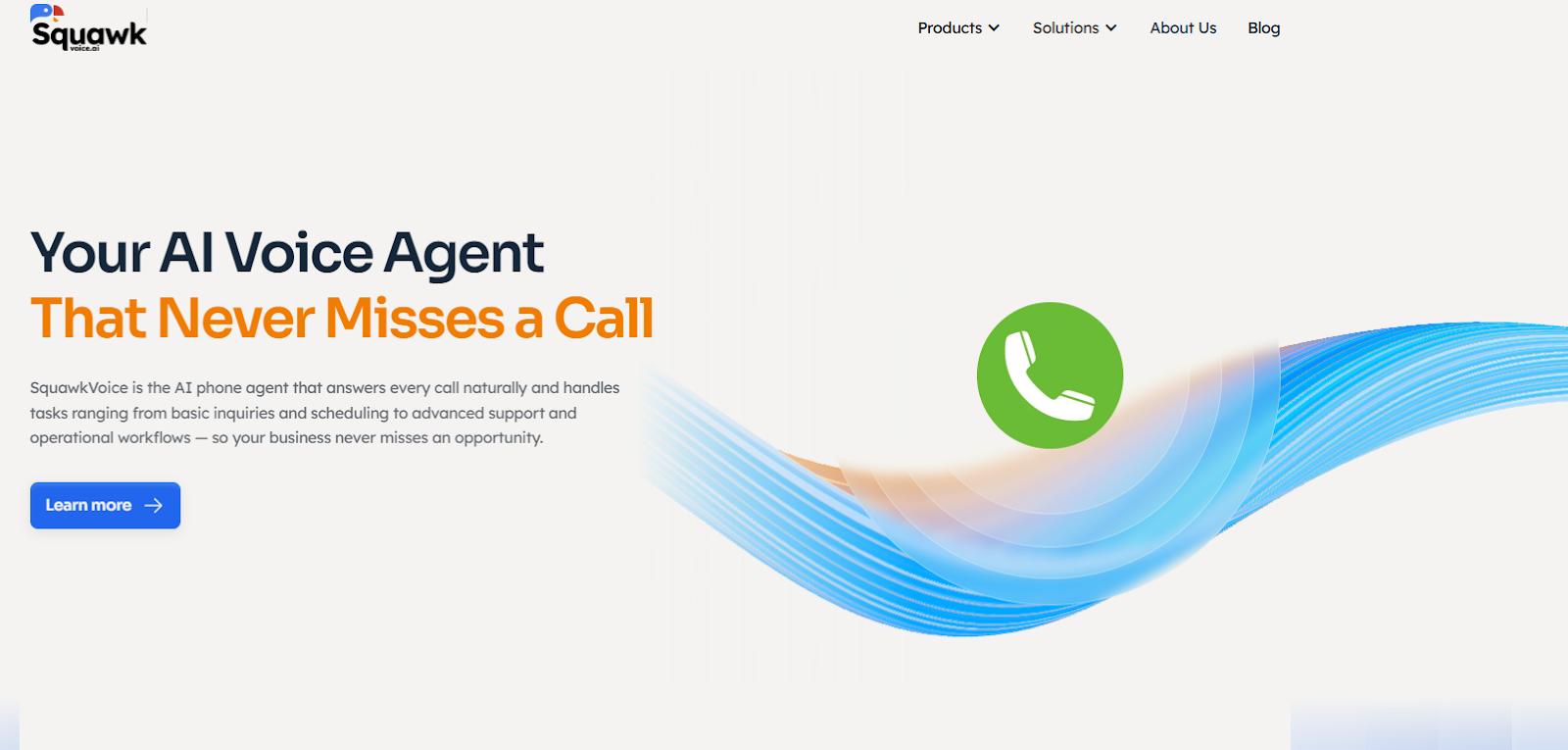
Pricing: Typically subscription-based, aligned to call volume and workflow requirements.
Best for: Teams that want voice automation to reduce missed calls and complete routine front-desk work during calls without turning setup into a lengthy engineering project.
2. Retell AI
Overview: Retell AI is a modular platform for building and running AI voice agents. It’s popular with teams that want to choose their components (LLM, voice engine, telephony) and iterate quickly without committing to an enterprise rollout.
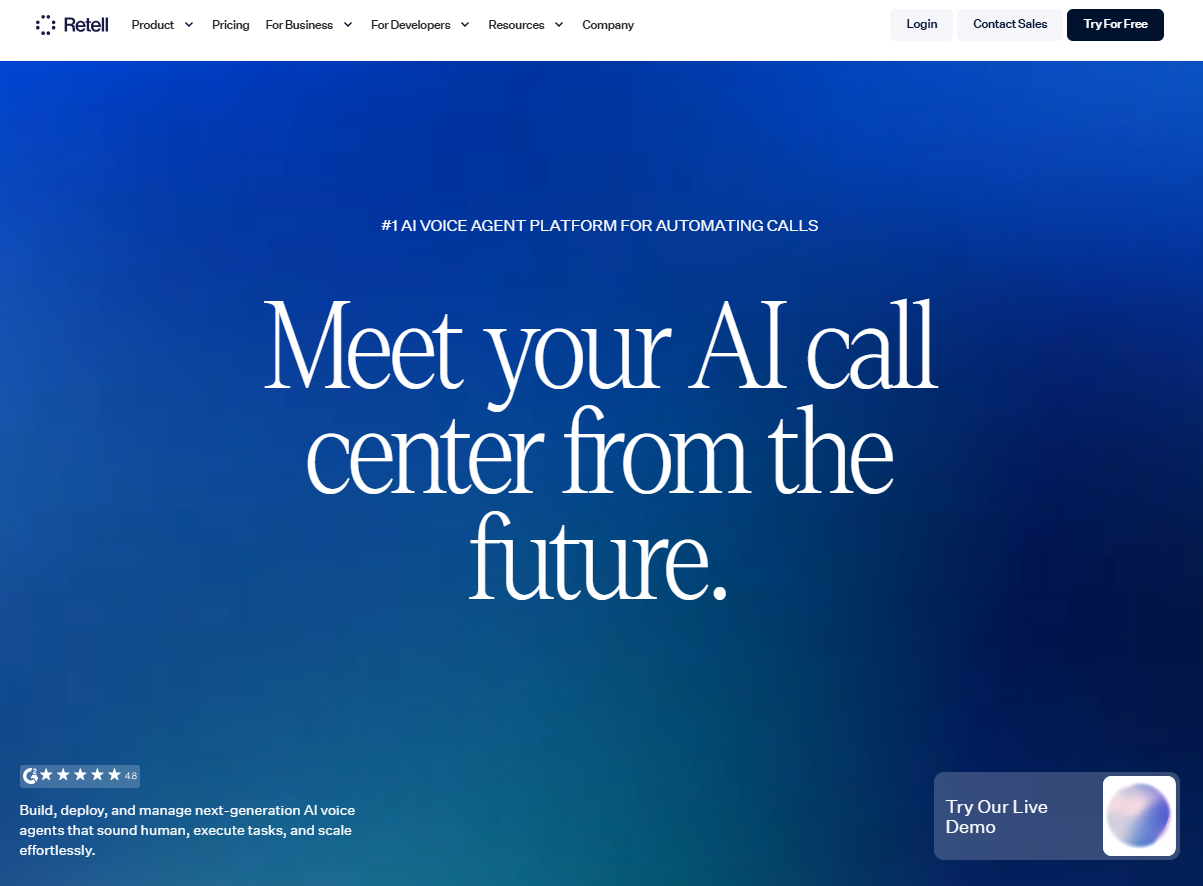
Pricing: Retell lists $ 0.07 per minute for AI voice agents (platform).
Best for: Builder-oriented teams that want control over the voice-agent stack and expect to iterate on prompts, tools, and integrations as they learn from real calls.
3. Synthflow
Overview: Synthflow is a no-code voice agent builder with an agency-friendly approach (including features such as concurrency management and, in some configurations, white-label tooling). It appeals to teams that want to ship voice flows without building a full engineering stack.
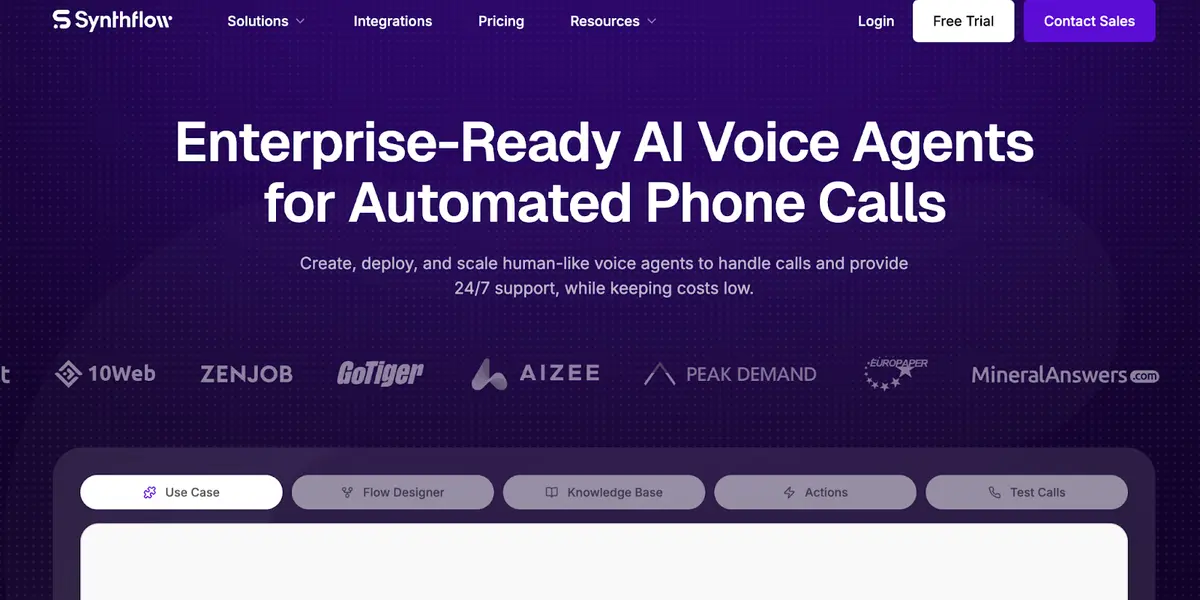
Pricing: Synthflow lists Pay-as-you-go at $0.15–$0.24 per minute with a $0/month base price; Enterprise is custom.
Best for: Operators and agencies looking to launch voice agents quickly with a no-code workflow builder, especially when a pilot-first approach is critical.
4. Poly AI
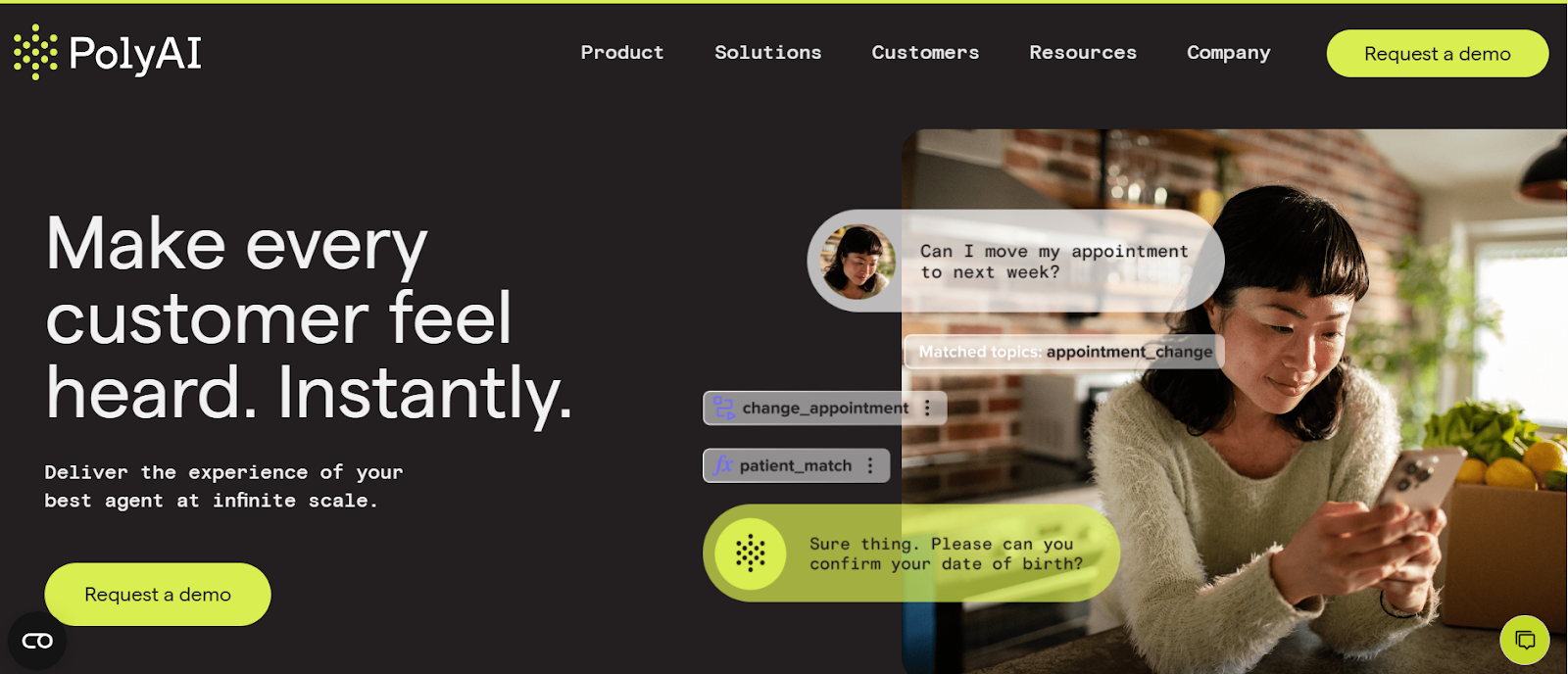
Overview: PolyAI is an enterprise-focused voice assistant platform built for large contact centers. It’s often evaluated for conversational quality and multilingual support in high-volume environments.
Pricing: Custom
Best for: Large enterprises with established contact center operations and long deployment cycles.
5. ElevenLabs
Overview: ElevenLabs is widely known for voice quality, and its Agents product provides an agent runtime for voice interactions, with built-in features such as monitoring, tools/events, and knowledge base support, as documented in its documentation.

Pricing: ElevenLabs offers tiers: Free (15 mins), Starter ($5, 50 mins), Creator ($22, 250 mins), Pro ($99, 1,100 mins), Scale ($330, 3,600 mins), and Business ($1,320, 13,750 mins).
Best for: Product teams building voice experiences where speech quality and controllable agent behavior matter, and where you want a documented agent runtime rather than a full receptionist out of the box
How to Choose the Best AI Voice Agent for Your Business
The real test is whether a platform fits your specific call patterns, integrates with your actual tech stack, and scales with your business without surprise costs. Before you compare feature lists, step back and evaluate your needs against these five factors:
1. Map your call patterns first: Understand your volume, the percentage of routine vs. complex calls, and the most common requests. This determines how much automation is realistic and where the biggest ROI sits.
2. Evaluate integration depth: A voice agent that can't access your actual CRM or scheduling data is limited to generic responses. The best platforms pull live data during calls, making every interaction contextual.
3. Match technical requirements to your team: Some platforms are developer-first; others are fully no-code. Choose based on who will actually build and maintain the workflows.
4. Prioritize pay-as-you-go pricing: Flexible pricing lets you scale gradually without committing to large contracts before you've validated the results.
5. Test escalation quality above all else: The moment AI hands off to a human is the most critical transition. Full context transfer, where the human agent sees everything the AI discussed, makes or breaks the experience.
Why SquawkVoice Is the Best AI Voice Agent Provider
SquawkVoice was built around a simple belief: every call matters, and your team deserves to focus on work that actually requires their skills.
What makes it different starts with recognizing that a solo plumber and a 200-person healthcare clinic have very different needs, yet both require every call to be answered. Here's what sets SquawkVoice apart:
- Serves both ends of the spectrum. A mobile app that a solopreneur can set up in five minutes, and a web application with custom workflows, deep integrations, and enterprise-grade analytics for larger operations. No other platform covers both.
- Natural, low-latency conversations. Routine calls are handled seamlessly, while complex situations are escalated intelligently with full context. Your team never picks up a transferred call blind.
- Built-in CRM, transcription, and analytics. Everything you need to track performance and improve over time, without stitching together multiple tools.
For solopreneurs, SquawkVoice means never losing a job because you were on a job. For mid-market companies, it means finally breaking the link between call volume growth and headcount growth. Every caller gets an answer, your team works on what matters, and your costs stop scaling linearly with demand.
Because every call matters. Get started with SquawkVoice today
FAQs
Can AI voice agents replace call centers?
Not entirely. AI voice agents can handle routine, high-volume calls (order status, scheduling, FAQs) that account for the majority of a support team's time. Humans need to step in for complex issues and emotionally sensitive situations.
What is the difference between a chatbot and an AI voice agent?
Chatbots use text; voice agents conduct spoken conversations over the phone. Voice agents pick up tonal cues, resolve issues faster (speaking is quicker than typing), and are more accessible to callers who are uncomfortable with digital interfaces. Many businesses use both.
How much does an AI voice agent cost?
Pricing typically ranges from $0.10 to $0.20 per minute.
Which industries benefit from AI voice agents?
Healthcare, home services, financial services, retail and e-commerce, real estate, and professional services see the strongest adoption.
Is an AI voice agent better than IVR?
For most use cases, yes. IVR forces callers into rigid menus; voice agents understand natural language and resolve issues during the call.