%201.svg)


.png)


A few years ago, automation in the call center usually meant an IVR menu or chatbots and a promise that a human would eventually pick up. In 2026, the conversation is about AI voice systems that can speak naturally, understand intent, and retrieve information from business tools quickly enough that the interaction feels like a real conversation.
Will AI replace call center agents? Not in the way the headlines suggest. What’s actually happening is more practical:
- AI is replacing parts of work in support conversations, including verification, routing, order status, scheduling, and basic troubleshooting.
- Humans are shifting up the value chain: complex problem-solving, judgment calls, empathy-heavy situations.
- The winners are building hybrid systems in which AI handles the repeatable 30–70% of queries and humans handle the messy 30–70%.
Gartner predicts that automation will accelerate: it expects agentic AI to autonomously resolve 80% of common customer service issues by 2029, driving a 30% reduction in operational costs.
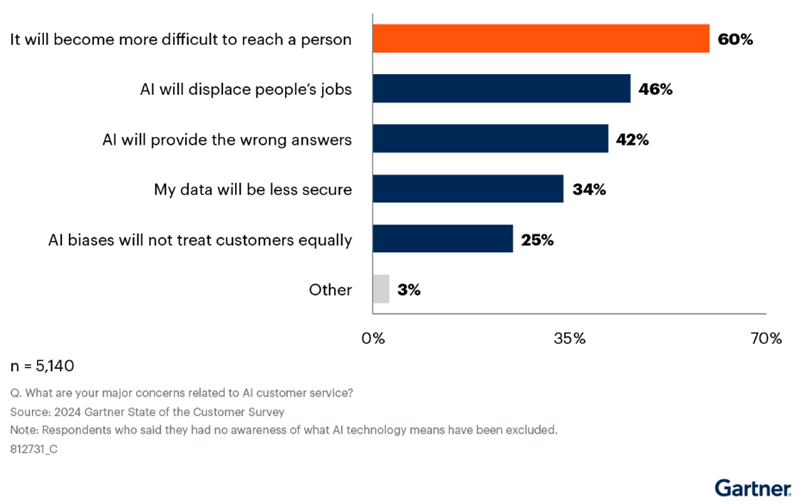
At the same time, Gartner also found that 64% of customers would prefer companies not to use AI for customer service, and 53% would consider switching if they learned a company planned to use AI in service.
What is actually happening in call centers today, and what does it mean for agents? Let’s walk through the real use cases, the real limitations, and the scenarios where “replacement” is plausible.
How AI Is Used In Call Centers Today
In most contact centers, AI is deployed across three layers: customer-facing automation, agent assistance, and back-office intelligence.
Customer-facing automation
This includes voice agents and chatbots that answer common questions and complete straightforward requests. It works best when the outcome is clear, and the workflow is well integrated, such as checking order status, booking an appointment, updating account details, or guiding a customer through basic troubleshooting.
Agent Assistance
This is often the faster path to value because it improves human agents’ performance without changing the customer front-end experience. Many teams use AI to shorten handle time, reduce after-call work, and improve consistency in how agents follow policy.
Microsoft has shared examples from its customer service operations in which Copilot reduced average chat case handling time by up to 16% and enabled agents to handle up to 12% more cases.
A typical agent assist setup helps with tasks like:
- Summarizing the customer’s issue and recent history so the agent starts with context
- Suggesting next steps based on intent, policy, and past resolutions
- Surfacing relevant knowledge base content while the customer is still on the line
- Drafting wrap-up notes and summaries to reduce after-call documentation
Analysis and QA
AI can transcribe and tag calls at scale, identify themes, flag compliance risks, and spot coaching opportunities. Even teams that are cautious about customer-facing bots often adopt AI here because it improves visibility into what is happening across thousands of interactions.
Across all three layers, organizations achieving reliable outcomes integrate AI into systems that drive work, such as CRMs, scheduling tools, order management, billing, identity verification, and ticketing. When those integrations are missing, automation often stalls at the information-only stage, which rarely satisfies customers.
What AI Still Can’t Fully Replace
Call center work is not only about answering questions. It also involves judgment, trust, and risk management. AI can perform well on routine workflows but still struggles in higher-stakes moments.
Let’s look at four limitations of AI agents that continue to keep humans in the loop.
1. Emotional context
Customers often call when something has gone wrong, when they are confused, or when they are already frustrated. A calm response helps, but empathy in these moments is not a script. It is a form of accountability and reassurance that the other side understands what is at stake.
In high-stress situations, a voice agent that sounds confident but cannot resolve the issue can increase anger rather than reduce it. This is one reason customer sentiment about AI support remains mixed, even while operational leaders push automation forward.
2. Policy exceptions
Many real calls sit just outside the boundaries of your most common flows. A customer may be ineligible for a refund on paper but clearly deserves an exception. A delivery may show as delivered, yet the customer has a credible theft issue. A family member may need to close an account without access to credentials.
These cases require context-driven decisions that involve tradeoffs between strict policy enforcement and customer retention. Humans are still better at weighing nuance, choosing the right exception, and taking ownership of the outcome.
Customer Concerns About AI in Customer Service
3. Messy systems and unclear ownership
AI can retrieve information, but many support organizations still operate across fragmented tools, partial customer histories, and unclear ownership across teams. Humans often succeed by improvising within that mess: looping in a specialist, escalating internally, applying practical shortcuts, and making judgment calls when the workflow does not neatly exist.
This messy middle is also why many companies have found AI adoption harder than expected. Reuters reports that executives and advisors frequently describe generative AI as difficult to operationalize at scale, with inconsistent performance and integration challenges slowing the realization of value.
4. Trust, identity, and fraud defense
Identity verification, account takeovers, and social engineering attempts are common in voice channels. AI can support verification steps and anomaly detection, but greater automation also increases the need for guardrails.
Voice interactions that involve account changes, sensitive data, or financial decisions require verification and careful monitoring. In many industries, it is still safer to keep a human in the loop for the highest-risk actions.
Why AI Won’t Fully Replace Agents (At Least Not Yet)
Even if AI capabilities continue to improve, full replacement faces three constraints that are more about the ecosystem around the model than about the model itself.
First, customer acceptance remains uneven. PwC’s 2025 Customer Experience Survey finds that people are willing to use AI for specific tasks, such as tracking an order or delivery status, but 86% say human interaction is moderately or very important to their brand experience.
Pew Research also finds a gap between how experts and the general public experience chatbots. About 61% of AI experts who have used a chatbot said it was extremely or very helpful, compared with 33% of the general public.
Second, reliability and rollout complexity slow down ambitious automation targets. Reuters’ reporting captures a pattern: impressive demos, followed by slow progress when systems meet the real world: Company policy, messy data, and unpredictable call flows.
Third, there is organizational risk. Service interactions are often tied to compliance, brand reputation, and revenue protection. Leaders may automate aggressively in lower-risk zones, but still want human ownership when the downside of a wrong decision is high.
This combination is why many call centers are building a staged approach: automate what can be measured cleanly, increase coverage over time, and redesign the human role to handle escalations.
AI + Human Agents: Hybrid Model for Call Centers
The most common model for 2026 is hybrid. In a hybrid contact center, AI handles a defined set of repeatable requests, and humans handle exceptions, escalations, and complex resolutions. AI also supports humans during live calls with summaries, guidance, and automation of after-call work.
There are two practical ways to implement a hybrid.
The first approach is AI as the front line. AI answers, attempts to resolve routine intents, and escalates to a person when the situation is outside scope, high-risk, or emotionally sensitive. This model reduces queue pressure and provides 24/7 coverage, but it depends heavily on a clean handoff so the customer does not have to repeat themselves.
The second approach is human-first with AI assistance. Customers reach a person quickly, while AI runs in the background to retrieve information, draft notes, and guide the agent through policy and workflows. This model avoids customer distrust of bots while still improving cost and consistency.
In practice, many teams blend both: front-line automation for the simplest call types and agent assist for everything else.
If you compare outcomes across industries, the hybrid model tends to win because it matches the real distribution of demand: a large share of calls are repetitive. In contrast, the calls that matter most are the hardest to automate.
Impact of AI on Call Center Jobs
AI is changing call center work and the skills support teams need. Some roles will shrink over time, while new roles emerge around AI operations and workflow automation.
The U.S. Bureau of Labor Statistics projects employment for customer service representatives will decline 5% from 2024 to 2034. It also projects a large number of annual openings driven by turnover and replacement needs, suggesting a gradual reshaping rather than an immediate collapse.
Currently, the growth centers around AI support roles. Many organizations are already building functions around:
- Conversation design and continuous improvement
- Knowledge base operations and content governance
- AI monitoring, QA, and compliance review
- Workflow automation and integration engineering
What Do Customers Prefer: AI or Human?
Customers rarely think in categories like AI and human. They evaluate experiences based on time, effort, and whether the interaction ends in a real outcome.
The strongest signal from research is that customers still place high value on human interaction, especially as part of building trust and enhancing the brand experience. Gartner’s findings show direct resistance to AI in customer service among many customers. PwC’s survey referenced above reinforces that human interaction remains central to the brand experience, even as people increasingly rely on AI for specific tasks.
Pew’s research cited above adds a subtle operational detail: many people in the general public have mixed experiences with chatbots, which helps explain why “helpfulness” is a stronger driver of acceptance than novelty.
A useful implication emerges from these sources: automation works best when customers can see progress quickly and when a human path is readily accessible in moments that carry greater emotional impact or risk.
Where AI Might Fully Replace Agents (Future Scenarios)
Full replacement is most plausible in environments with three traits: standardized requests, clean data access, and low downside from a wrong decision.
Here are three scenarios where you could see near-total automation in specific service segments.
Scenario 1: Highly standardized, high-volume service catalogs
Some businesses have a narrow range of requests, clear outcomes, and a minimal exception policy. If the system can authenticate the user, access the appropriate data, and complete the action end-to-end, there is little reason to involve humans in every interaction.
Scenario 2: Mature identity and fraud controls in voice channels
If the verification mechanism is strong enough for sensitive actions to be completed safely without a human checkpoint, automation can expand into deeper account management. This depends on industry, regulation, and the sophistication of fraud attempts in that vertical.
Scenario 3: Service ecosystems built for machine-to-machine interaction
As more customers use assistants to manage tasks, a growing share of service interactions will occur between automated systems, particularly for routine updates and status checks. Gartner’s broader forecast for agentic AI points in this direction, though timelines vary by industry.
Even in these futures, many brands will continue to use human support as a differentiator, especially for premium tiers and high-stakes issues.
The Way Forward is Hybrid
AI is changing call centers quickly, but replacement is the wrong operational target for most teams in 2026. The better target is designing a service system that uses automation where it is reliable and fast, and preserves human ownership where trust and judgment matter most.
If you are planning the next 12 months, a practical roadmap usually looks like this:
- Start with call-driver analysis and select a small set of workflows where success is easy to measure.
- Connect those workflows to the systems that resolve the work so the experience feels complete.
- Design the escalation and context handoff early, then continuously improve it based on outcomes and QA.
SquawkVoice is built for that hybrid reality. If you want to see what a modern voice workflow looks like for your call types, SquawkVoice can help you map the right automation scope, connect it to your systems, and go live with clean handoffs that protect the customer experience.
FAQs
Will AI replace call center agents completely?
In most industries, full replacement is unlikely in the near term. Forecasts suggest AI will resolve a large share of common issues over time, while humans remain involved in complex and high-stakes cases.
What call center jobs are most at risk from AI?
Roles that rely heavily on repetitive, scriptable requests are most exposed, especially when workflows are standardized and outcomes are clear.
What tasks can AI already handle?
AI can handle routine intent capture, basic troubleshooting, scheduling, order status checks, and a range of agent-assistance tasks, particularly when connected to CRM and operations systems.
Are customers okay with AI support?
Many customers accept AI when it delivers an immediate resolution, but surveys also show a strong preference for human support overall and concerns about being unable to reach a person.
What is the hybrid AI-human call center model?
It is a model in which AI handles a defined set of routine requests and escalates the rest to humans with full context, while also assisting agents on complex calls with summaries and guidance.
How can call centers prepare for AI?
Start with call-driver analysis, clean up the knowledge base, invest in integrations that enable end-to-end workflow completion, and design escalation so customers can reach a person easily when needed.
Will AI improve customer service?
It can improve customer service by reducing wait times and effort, and by giving agents with better context and support. Results depend heavily on integration quality and experience design.
What jobs will AI create in call centers?
AI is creating demand for roles in conversation design, knowledge operations, AI QA and monitoring, compliance review, analytics, and workflow automation.